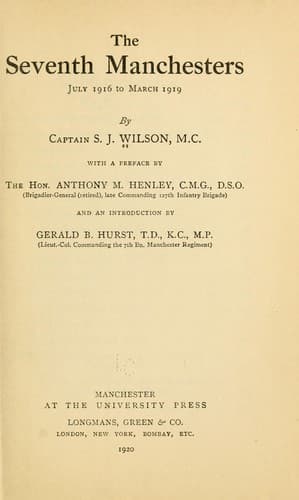
The Seventh Manchesters: July 1916 to March 1919Wilson, S. J.
History
The Seventh Manchesters: July 1916 to March 1919
Wilson, S. J.
Great Britain. Army. Manchester Regiment. Battalion, 7th (Territorial); World War, 1914-1918 -- Regimental histories -- Great Britain
On August 14th the 42nd Division moved back to Romani, a further advance
across the Sinai Desert being deemed inadvisable until the railway and
water pipe, which stopped a few kilometres beyond Romani, had been
pushed further ahead. A system of training was started, but as the men
had not recovered from the fatigue of the Katia operations, and the
weather was very trying, vigorous forms of exercise were given up. A
number of men went to hospital with a weakening form of diarrhoea
almost akin to dysentery, while the medical authorities were in a highly
nervous state about cholera of which a few cases had been reported. It
was presumed that this had been contracted from the Turkish prisoners
and their old camping grounds.
The battalion was augmented slightly at this stage by a draft from
England, while 2nd-Lt's. W. H. Barratt and W. Thorp returned from leave.
Lt. H. C. Franklin, M.C., one-time R.S.M., went into hospital and was
invalided to England, and his place as Adjutant was taken by Capt. J. R.
Creagh, a position he filled admirably for more than two years. Captains
C. Norbury and B. Norbury left the battalion about this time to obtain
appointments in England and France and this entailed a change in Company
Commanders. Captains Tinker and Higham continued to command "A" and "D"
Companies, Lt. H. H. Nidd was given "B" Company, and Captain Chadwick
"C" Company. 2nd-Lt. G. W. Franklin assisted the Adjutant in the Orderly
Room, while 2nd-Lt. F. Grey Burn was employed as "Camel Officer;" new
work brought about by the substitution of camel for wheeled transport.
The bulk of the latter remained at Kantara under 2nd-Lt. M. Norbury,
with Capt. Ward Jones in charge of the Brigade transport; their duties
consisting chiefly in bringing rations, etc., across the canal from the
main station on the E.S.R. and loading them on the trains which ran over
the desert. Wheeled transport could not be employed in the desert
stations as roads had not been constructed.
Public-domain text, read in full here on John Shaqi.
Reviews
Reviews
No reviews yet
Be the first to share your thoughts on this work.
Join the Discussion
Join the discussion
Sign in to leave a comment or review.
Sign InorCreate an account