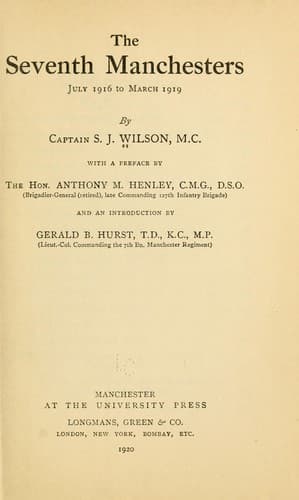
The Seventh Manchesters: July 1916 to March 1919Wilson, S. J.
History
The Seventh Manchesters: July 1916 to March 1919
Wilson, S. J.
Great Britain. Army. Manchester Regiment. Battalion, 7th (Territorial); World War, 1914-1918 -- Regimental histories -- Great Britain
We came to know the camel fairly well during the succeeding months, and
he proved a study, perhaps more interesting than his caretaker, a member
of the Egyptian Camel Corps' distinctive in his long blue garrabea. When
a company was on duty at a distant outpost the time for the arrival of
the ration camels was also the signal for the ration fatigue to fall in.
Then the string of animals would leisurely wend their way through the
gaps in the barb wire, their noses held high in an aristocratic leer,
each led with a head rope by a blue smocked Gyppie. The Q.M.S. would
appear: "'Tala Henna, Walad. Barrac Henna'" and so forth. A wonderful
flow of British-Arabic, grinningly comprehended by the natives, always
produces the desired result. The camel gets down in a series of bumps
and not without cautious glances at his head, the men unfasten the
complication of ropes and commence the work of unloading. Somebody
shouts: "Mail up!" and this brings out a number of interested faces from
the entrances to "bivvies." After the rations have been sorted out, word
quickly goes round, "Six to a loaf again, and no fresh meat to-day," so
everyone looks gloomily ahead to the prospect of swallowing quantities
of bully beef and biscuits. Other camels have carried up trench and
wiring materials, and when all are off-loaded they get up wearily and
solemnly depart leaving the outpost to its solitary existence. If there
is only one officer he feels his solitude very much, for in spite of the
camaraderie with the men and particularly the senior N.C.O's. there is a
feeling of restraint due to the requirements of military discipline, and
he misses the value of perfectly free intercourse.[1]
[Footnote 1: Quoted from an Officer's Diary]
[Illustration: _PLATE III_
1. Bivouac Shelters on the Desert
2. Making the Railway over the Desert
3. At El Mazar
4. Digging a Well]
It soon became apparent that an advance across the desert in the
direction of El Arish was contemplated, and that the speed of such an
advance would depend upon the rate at which the railway and water pipe
line could be constructed. The function of the troops was to protect it
from raiders so that work could proceed in comfort, a duty shared by the
mounted troops and the 52nd and 42nd Divisions. In September, therefore,
the 7th Manchesters left Romani for garrison duty at Negiliat, about
twenty kilos. further east. About this time Capt. Chadwick, who along
with Lt.-Col. Cronshaw, had been decorated with the Serbian Order of the
White Eagle in long delayed recognition of their magnificent work in
Gallipoli, left the battalion to join the R.F.C. in England and France.
Capt. Townson succeeded him in the command of "C" Company.
Public-domain text, read in full here on John Shaqi.
Reviews
Reviews
No reviews yet
Be the first to share your thoughts on this work.
Join the Discussion
Join the discussion
Sign in to leave a comment or review.
Sign InorCreate an account