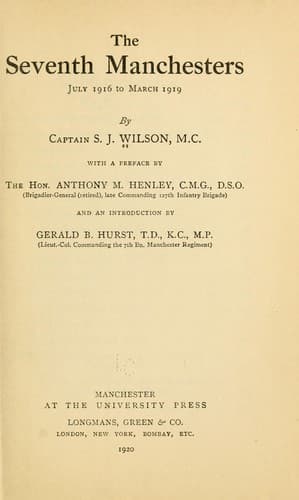
The Seventh Manchesters: July 1916 to March 1919 — John Shaqi
The Seventh Manchesters: July 1916 to March 1919Wilson, S. J.
History
The Seventh Manchesters: July 1916 to March 1919
Wilson, S. J.
Great Britain. Army. Manchester Regiment. Battalion, 7th (Territorial); World War, 1914-1918 -- Regimental histories -- Great Britain
As the health of the desert troops was not good after their long strain
under the tropical sun, a system of rest and holiday cure, suggested by
the medical authorities, was begun. Batches of men and officers were
sent off to Alexandria and encamped at Sidi Bishr, just outside the town
for a week, during which time they were free to do more or less as they
pleased, a concession highly relished by everyone. The sight of
civilisation alone was in itself almost a cure, but the change of the
surroundings, the lack of military duties, the sea bathing, and the
enjoyment of everything that dear old "Alex." could offer worked
wonders. Further, the hot season was drawing to a close and men began to
feel more normal, so that by the end of October the troops were as fit
as they had ever been in their lives. The 127th Brigade were withdrawn
to Romani whilst this work of recuperation was in progress, and the
beginning of November saw us back again at Negiliat.
Meanwhile, the mounted troops, closely supported by the infantry, kept
constant touch with the Turk. When the railhead reached the outpost line
it was necessary to move the enemy by force and to this end engagements
were fought at Bir el Abd, and at El Mazar, both of which resulted in
the Turk withdrawing upon El Arish. His aircraft was always busy, but
the bombing was not often effective. Even the natives in the E.L.C.
(Egyptian Labour Corps) began to grow accustomed to these raids and
steadily resisted their impulse to dash back along the line when a taube
was sighted.
The return from hospital of 2nd-Lt. Jimmy Baker and of 2nd-Lt. Joe
Chatterton at this time was greeted with pleasure by the battalion, and
all were interested in the arrival of the new Padre, the Rev. E. C.
Hoskyns. It was not long, however, before he had made himself thoroughly
well-known to every man who wore the Fleur de Lys, and his cheery face
was eagerly welcomed in every "bivvy." During unbroken service with us
until July, 1918, he maintained a proud record of spontaneous popularity
with all ranks, and especially with his brother officers.
Public-domain text, read in full here on John Shaqi.
Reviews
Reviews
No reviews yet
Be the first to share your thoughts on this work.
Join the Discussion
Join the discussion
Sign in to leave a comment or review.
Sign InorCreate an account