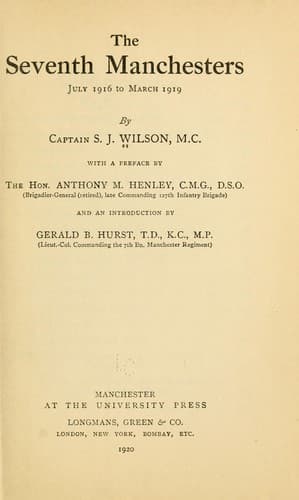
The Seventh Manchesters: July 1916 to March 1919Wilson, S. J.
History
The Seventh Manchesters: July 1916 to March 1919
Wilson, S. J.
Great Britain. Army. Manchester Regiment. Battalion, 7th (Territorial); World War, 1914-1918 -- Regimental histories -- Great Britain
There was naturally a good deal of digging to be done in this sector,
and although relieved eventually in the front positions by the 5th, the
battalion found itself up in the line each night making continuous
trenches. It was in connection with this work that we lost our
brigadier, General Ormsby. On the night of May 1st, he, with a number of
R.E. officers, was examining the position near Catelet Copse when the
Boche suddenly started a short hurricane bombardment. The trench he was
in was only waist deep, and soldier and leader to the end he disdained
to take full advantage of the scanty shelter, preferring to set an
example of calmness and steadiness under fire to his men. A piece of
shell struck him in the head and he died almost immediately. This was a
great blow to the brigade, just at the commencement of their adventure
in the new warfare. It was sadly remarkable, too, that he himself was
the first officer casualty in his brigade. A few days later, during
which time Lt.-Col. Darlington of the 5th assumed command, the new
brigadier arrived--General Henley, D.S.O.--and we were fortunate to keep
him as our Commander until the end of the war. The brilliant record of
the 127th brigade in France is testimony to his qualities as a leader,
and it was not very long before every man and officer in the Manchesters
was proud of him. General Ormsby always remained, however, as a tender
memory to those who had served under him.
Villers Faucon, which had been the rear H.Q. and transport lines was
invaded by battalion H.Q. and two companies when the battalion moved
back into reserve, but we did not stay long here, because the 126th
brigade required assistance in the completion of their trench system in
front of Templeux, and to do this we had to move into the quarries in
that district. The other two companies carried out similar work in the
vicinity of Lempire and Ronssoy. There was very little of interest
during the succeeding days after which the brigade moved out to Roisel
prior to accompanying the division to the Havrincourt sector of the
front.
HAVRINCOURT.
At the end of May the battalion marched out with the remainder of the
brigade from Roisel and in one day reached their destination behind the
Havrincourt Wood sector. We there remained for a short period in the
region of Ytres and Fins. Little time was lost in the necessary
preliminaries and we relieved a battalion of the Duke of Cornwall's L.I.
of the 21st division in support in the wood. "D" company were early
unfortunate and suffered a number of casualties from heavy shelling on
the shallow trenches which they manned near the western edge of the
Wood. The enemy had noted the continued movement in this vicinity, and
suddenly decided to pay attention to it in the usual manner. This spot
was always remembered afterwards as "Where 'D' Company were shelled."
Public-domain text, read in full here on John Shaqi.
Reviews
Reviews
No reviews yet
Be the first to share your thoughts on this work.
Join the Discussion
Join the discussion
Sign in to leave a comment or review.
Sign InorCreate an account