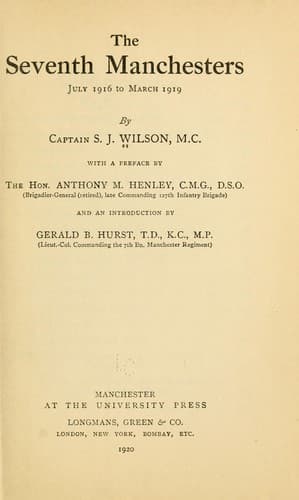
The Seventh Manchesters: July 1916 to March 1919Wilson, S. J.
History
The Seventh Manchesters: July 1916 to March 1919
Wilson, S. J.
Great Britain. Army. Manchester Regiment. Battalion, 7th (Territorial); World War, 1914-1918 -- Regimental histories -- Great Britain
Conditions at Havrincourt were rather different from those at Epehy,
although the same characteristics due to recent consolidation still
prevailed. It was more interesting, however, and in many senses more
"livable," a word of deep meaning on the Western front! In the British
lines--the canal, the slag-heap (or more correctly slag-heaps) and the
wood dominated all other landmarks. The canal, a portion of the Canal du
Nord, was in course of construction at the outbreak of war, and its
deep, well-laid bed is one of the engineering wonders of this part of
France. At Havrincourt it first runs west to east and then sharply bends
to the north towards Moeuvres past Hermies. The left of the 42nd
divisional front rested on the bend, after running over a huge chalk and
limestone slag-heap which stands at the corner. Going southwards the
line roughly skirted the eastern edge of the wood which lies upon a
slope facing the east.
Before their retirement, the Germans had cut down all trees on this
forward slope, some said in order to make use of the timber, others for
tactical reasons, so as to leave us exposed to view. I should say both
reasons weighed heavily with them, but principally the latter, for it
was noticeable that the woods in their own lines had not been so
denuded. Havrincourt village lay behind the enemy's front line on a
ridge that dominated our own positions. Further beyond were Flesquieres,
Marcoing, Premy Chapel and Ribecourt, where the main line of resistance
of the Hindenburg system could be plainly seen, while further over to
the left on the highest ground was Bourlon Wood, which was to become so
famous in the history of the British army. Every day the battalion
observers watched parties of Germans, large and small, working on these
rear trenches apparently quite unconcerned about the fact that they
could be plainly seen. Periodically our air service issued aeroplane
photographs showing the extraordinary development of these trenches,
their elaborate construction, the concrete dug-outs, and solid rows of
heavy barbed wire, until it almost came to be recognised that an assault
upon them would only be attempted by the maddest of leaders, and the
prospect of having to take part in it took one's breath away.
Public-domain text, read in full here on John Shaqi.
Reviews
Reviews
No reviews yet
Be the first to share your thoughts on this work.
Join the Discussion
Join the discussion
Sign in to leave a comment or review.
Sign InorCreate an account