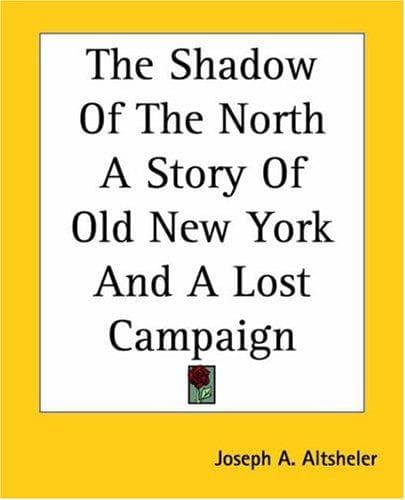
The Shadow of the North: A Story of Old New York and a Lost Campaign — John Shaqi
The Shadow of the North: A Story of Old New York and a Lost CampaignAltsheler, Joseph A. (Joseph Alexander)
History
The Shadow of the North: A Story of Old New York and a Lost Campaign
Altsheler, Joseph A. (Joseph Alexander)
United States -- History -- French and Indian War, 1754-1763 -- Juvenile fiction
Robert found the march not only pleasant but exhilarating. It
appealed to his imaginative and sensitive mind, which magnified
everything, and made the tints more vivid and brilliant. To him the
forests were larger and grander than they were to the others, and the
rivers were wider and deeper. The hours were more intense, he lived
every second of them, and the future had a scope and brilliancy that
few others would foresee. In company with youths of his own age coming
from the largest city of the British colonies, the one that had the
richest social traditions, his whole nature expanded, and he cast away
much of his reserve. Around the campfires in the evening he became one
of the most industrious talkers, and now and then he was carried away
so much by his own impulse that all the rest would cease and listen to
the mellow, golden voice merely for the pleasure of hearing. Then
Tayoga and Willet would look at each other and smile, knowing that
Dagaeoga, though all unconsciously, held the center of the stage, and
the others were more than willing for him to hold it.
The friendships of the young ripen fast, and under such circumstances
they ripen faster than ever. Robert soon felt that he had known the
three young Philadelphians for years, and a warm friendship, destined
to last all their lives, in which Tayoga was included, was soon
formed. Robert saw that his new comrades, although they did not know
much of the forest, were intelligent, staunch and brave, and they saw
in him all that Tayoga and Willet saw, which was a great deal.
The heat and dryness increased, and the brown of leaf and grass
deepened. Nearly all the green was gone now, and autumn would soon
come. The forest was full of game, and Willet and Tayoga kept them
well supplied, yet their progress became slower. Those who had been
wounded severely approached the critical stage, and once they stopped
two days until all danger had passed.
Three days later a fierce summer storm burst upon them. Tayoga had
foreseen it, and the whole troop was gathered in the lee of a hill,
with all their ammunition protected by blankets, canvas and the skins
of deer that they had killed. But the young Philadelphians,
unaccustomed to the fury of the elements in the wilderness, looked
upon it with awe.
In the west the lightning blazed and the thunder crashed for a long
time. Often the forest seemed to swim in a red glare, and Robert
himself was forced to shut his eyes before the rapid flashes of
dazzling brightness. Then came a great rushing of wind with a mighty
rain on its edge, and, when the wind died, the rain fell straight down
in torrents more than an hour.
Public-domain text, read in full here on John Shaqi.
Reviews
Reviews
No reviews yet
Be the first to share your thoughts on this work.
Join the Discussion
Join the discussion
Sign in to leave a comment or review.
Sign InorCreate an account