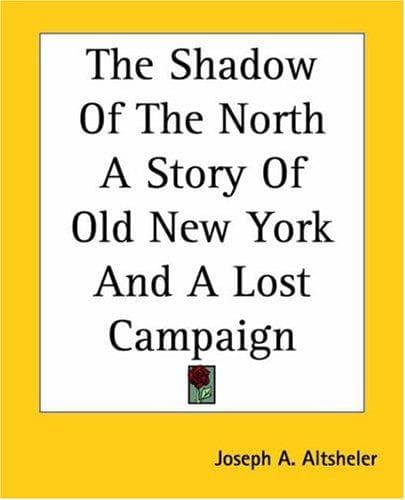
The Shadow of the North: A Story of Old New York and a Lost Campaign — John Shaqi
The Shadow of the North: A Story of Old New York and a Lost CampaignAltsheler, Joseph A. (Joseph Alexander)
History
The Shadow of the North: A Story of Old New York and a Lost Campaign
Altsheler, Joseph A. (Joseph Alexander)
United States -- History -- French and Indian War, 1754-1763 -- Juvenile fiction
Although they kept their ammunition and other supplies dry the men
themselves were drenched to the bone, but the storm passed more
suddenly than it had come. The clouds parted on the horizon, then all
fled away. The last raindrop fell and a shining sun came out in a hot
blue sky. As the men resumed a drooping march their clothes dried fast
in the fiery rays and their spirits revived.
When night came they were dry again, and youth had taken no harm. The
next day they struck an Indian trail, but both Willet and Tayoga said
it had been made by less than a dozen warriors, and that they were
going north.
"It's my belief," said Willet, "that they were warriors from the Ohio
country on their way to join the French along the Canadian border."
"And they're not staying to meet us," said Colden. "I'm afraid, Will,
it'll be some time before you have a chance to show your unbottled
Quaker valor."
"Perhaps not so long as you think," replied Wilton, who had plenty of
penetration. "I don't claim to be any great forest rover, although I
do think I've learned something since I left Philadelphia, but I
imagine that our building of a fort in the woods will draw 'em. The
Indian runners will soon be carrying the news of it, and then they'll
cluster around us like flies seeking sugar."
"You're right, Mr. Wilton," said Willet. "After we build this fort
it's as sure as the sun is in the heavens that we'll have to fight for
it."
Two days later they reached the site for their little fortress which
they named Fort Refuge, because they intended it as a place in which
harried settlers might find shelter. It was a hill near a large creek,
and the source of a small brook lay within the grounds they intended
to occupy, securing to them an unfailing supply of good water in case
of siege.
Now, the young soldiers entered upon one of the most arduous tasks of
the war, to build a fort, which was even more trying to them than
battle. Arms and backs ached as Colden, Wilton and Carson, advised by
Willet, drove them hard. A strong log blockhouse was erected, and then
a stout palisade, enclosing the house and about an acre of ground,
including the precious spring which spouted from under a ledge of
stone at the very wall of the blockhouse itself. Behind the building
they raised a shed in which the horses could be sheltered, as all of
them foresaw a long stay, dragging into winter with its sleet and
snow, and it was important to save the animals.
Robert, Willet and Tayoga had a roving commission, and, as they could
stay with Colden and his command as long as they chose, they chose
accordingly to remain where they thought they could do the most
good. Robert took little part in the hunting, but labored with the
soldiers on the building, although it was not the kind of work to
which his mind turned.
Public-domain text, read in full here on John Shaqi.
Reviews
Reviews
No reviews yet
Be the first to share your thoughts on this work.
Join the Discussion
Join the discussion
Sign in to leave a comment or review.
Sign InorCreate an account