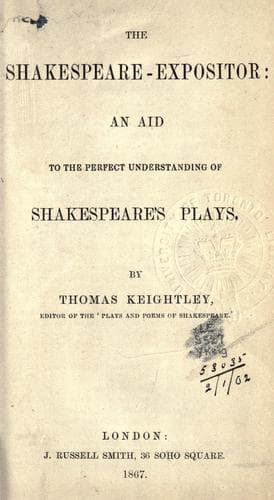
The Shakespeare-Expositor: An Aid to the Perfect Understanding of Shakespeare's Plays — John Shaqi
The Shakespeare-Expositor: An Aid to the Perfect Understanding of Shakespeare's PlaysKeightley, Thomas
General
The Shakespeare-Expositor: An Aid to the Perfect Understanding of Shakespeare's Plays
Keightley, Thomas
Drama -- Outlines, syllabi, etc.; Shakespeare, William, 1564-1616 -- Outlines, syllabi, etc.
N.B. The reader will observe with respect to these last four comedies,
that all that we know with certainty respecting their date is that they
were written between 1597 and 1600 or 1602. The arranging of them is
little more than guess-work. I have placed first those that we _know_
to have been written before 1600.
MEASURE FOR MEASURE.
_Edition._ Only in the folio, 1623.
_Date._ In the Accounts of the Revels at Court, we are informed
that this play was performed at Whitehall December 26, 1604. It was
therefore probably written in that or the preceding year.
_Origin._ "The right excellent and famous History of Promos and
Cassandra, a drama in Two Parts, by George Whetstone," published
in 1578. Whetstone's drama was taken from one of the tales in the
Hecatommithi of Cinthio, which Shakespeare may also have read. The
comic scenes are of course all his own.
THE WINTER'S TALE.
_Edition._ Only in the folio, 1623.
_Date._ It appears from the MS. diary of Dr. Forman, that he saw this
play performed at the Globe, May 15, 1611; it was also performed at
Whitehall on the 5th of November following. Its exact date cannot be
assigned; but the great probability is that it could not have been
written earlier than 1610. I am disposed to regard it as anterior to
The Tempest, which was probably the last play that ever Shakespeare
wrote. When we consider the probable date of this play, we see how
utterly untenable is the theory of some writers that it was an
indirect apology for Anne Boleyn, and a direct compliment to her royal
daughter. I may here observe that those ingenious persons who find
allusions (except in a very few plain instances) to public events and
public persons in Shakespeare's plays merely waste their own and their
readers' time. Thus Sir Philip Sidney died the very year the poet came
to London; and yet we are told that he is figured in Hamlet, a play not
written till many years afterwards!
_Origin._ With the exception of the comic scenes--which as usual are
wholly Shakespeare's own--it was founded on Green's popular novel of
Pandosto, The Triumph of Time.
THE TEMPEST.
_Edition._ Only in the folio, 1623.
_Date._ As it (II. 1) copies a passage from Florio's translation
of Montaigne's Essays, published in 1603, we may assume that it is
posterior to that year; and Malone has directed attention to the
shipwreck of Sir George Somers on the island of Bermuda in July 1609,
which may have suggested the scene of "The Tempest." We may therefore
venture to assume that it may have been written not long after the
account of that event reached England.
Public-domain text, read in full here on John Shaqi.
Reviews
Reviews
No reviews yet
Be the first to share your thoughts on this work.
Join the Discussion
Join the discussion
Sign in to leave a comment or review.
Sign InorCreate an account