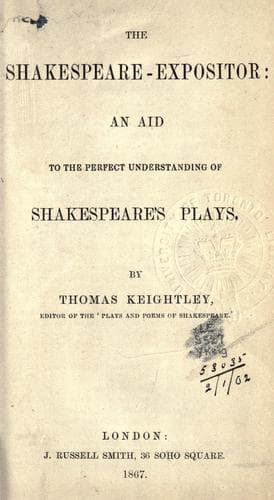
The Shakespeare-Expositor: An Aid to the Perfect Understanding of Shakespeare's PlaysKeightley, Thomas
General
The Shakespeare-Expositor: An Aid to the Perfect Understanding of Shakespeare's Plays
Keightley, Thomas
Drama -- Outlines, syllabi, etc.; Shakespeare, William, 1564-1616 -- Outlines, syllabi, etc.
_Date._ It was entered in the Stationers' Registers 18th January
1601-02, and was, consequently, written between 1597 (it is not in
Meres's list) and that date; but we have no means of ascertaining the
exact time. Mr. Dyce thinks it was written before 1600. It may be
observed that, though some of the characters are the same as those in
Henry IV. and Henry V., it is quite independent of these plays. I must
here remark that the play is so brief, and, as it were, elementary, in
the 4tos as compared with the folio, that it seems quite clear that the
poet revised and augmented it some time after its first appearance; and
this gives some probability to the tradition of its having been written
at the command of the Queen, and in a few days, possibly in 1598 or
1599. Further, as in the 4tos there is no allusion whatever to the Lucy
coat of arms, it is highly improbable that the poet showed in it any
ill feeling towards that family. Lastly, the occurrence in the 4tos of
numerous riming couplets which are not in the folio, completely upsets
Mr. Collier's theory of that edition having been made up from memory,
and from notes taken at the theatre. The expression "_king's_ English"
(I. 4) might seem to indicate that the enlargement of the play was not
made till after the accession of James. The change, however, of _queen_
to _king_ may have been made by the Editors; but surely Shakespeare
must have been aware that Falstaff lived in the time of the Henries.
_Origin._ Though some Italian and English tales are referred to as the
possible sources of the plot, we may, I think, regard it as, at least
in the greater part, Shakespeare's own invention. There is, however, a
strong resemblance in part of it to a German play by Duke Henry Julius
of Brunswick, who died in 1611. See on The Tempest.
TWELFTH NIGHT.
_Edition._ Only in the folio, 1623.
_Date._ We learn from the MS. diary of a barrister named Manningham,
that this play was performed in the Middle Temple, on the 2nd of
February 1601-02. It was therefore written between 1597 and that date;
but the exact time is quite uncertain.
_Origin._ The more remote origin of this play is apparently one of the
tales of Bandello, which Shakespeare may have read in the original,
or in a French or English version of it; for there were such. But the
Rev. Jos. Hunter directed attention to three Italian comedies, two
named "Inganni"--one of which is noticed by Manningham--and a third
named "Gl'Ingannati," or "Il Sacrificio;" and the resemblance between
this last and Twelfth Night is so strong that it is hardly possible
to suppose that Shakespeare was unacquainted with it. If so, as it
was never translated, as far as we know, he must have read it in the
original Italian, which was printed in 1537.
Public-domain text, read in full here on John Shaqi.
Reviews
Reviews
No reviews yet
Be the first to share your thoughts on this work.
Join the Discussion
Join the discussion
Sign in to leave a comment or review.
Sign InorCreate an account