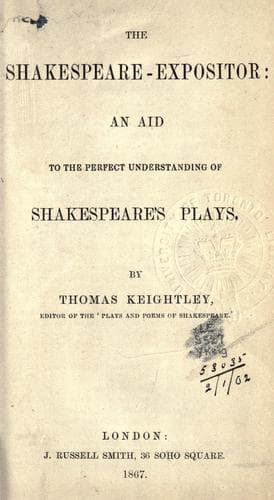
The Shakespeare-Expositor: An Aid to the Perfect Understanding of Shakespeare's Plays — John Shaqi
The Shakespeare-Expositor: An Aid to the Perfect Understanding of Shakespeare's PlaysKeightley, Thomas
General
The Shakespeare-Expositor: An Aid to the Perfect Understanding of Shakespeare's Plays
Keightley, Thomas
Drama -- Outlines, syllabi, etc.; Shakespeare, William, 1564-1616 -- Outlines, syllabi, etc.
_Date._ In Act I. Sc. 2, the Nurse says, "'Tis since the earthquake
now eleven years;" and, as Tyrwhitt justly observed, this could only
have been the earthquake which was felt in England on the 6th of April
1580. It was quite in Shakespeare's way to make the allusion; and this
would give 1591 as the year in which this play was first performed.
This, then, _may_ be the true date, though I greatly doubt of it; I
should rather say, entirely reject it; for it surely can hardly be
anterior to the first two comedies. The play, as appears from the 4to,
1597, was little more than a sketch of that which appeared, "corrected,
augmented, and amended," in 1599.
_Origin._ The remote original is the tale of Pyramus and Thisbe in
Ovid's Metamorphoses, from which an Italian writer named Luigi da Porto
made a tale, printed in 1535. A tale formed from this was given by
Bandello in 1554; and in 1562 a poem of Romeus and Juliet, by Arthur
Brookes, taken from Bandello's, or rather from the version of it in
Belleforest's Histoires Tragiques, was published in London; in 1567
the same tale, also from Bandello, appeared in Painter's Palace of
Pleasure. Shakespeare chiefly followed Brooke; but he had also read the
Palace of Pleasure, and probably Bandello's tale in the original.
HAMLET.
_Editions._ 4to, 1603; 4to, 1604; 4to, 1611; 4to undated (probably in
1607); in the folio, 1623.
_Date._ On the 26th of July 1602, an entry was made in the Stationers'
Registers of "A Booke, The Revenge of Hamlett, prince of Denmarke, as
yt was latelie acted, by the Lord Chambelayn his servantes." There
can be little doubt that this was the present play. The text of the
4to, 1603, is in such a mangled, wretched condition, that it has not
unreasonably been conjectured that it was formed from notes made during
the representation. As in this the Polonius and Reynaldo of the present
play are called Corambis and Montano, it is probable that the play
received much addition and alteration; for the 4to, 1604, gives it
"enlarged to almost as much again as it was, according to the true and
perfect coppie." This play being so popular, it is not unlikely that
the author may have frequently retouched it. It is very remarkable that
it is by many degrees the most faulty of his plays, abounding, we may
say, in incongruities, contradictions, and improbabilities.
_Origin._ Apparently a novel called The Hystorie of Hamblet, translated
from Belleforest. There seems also to have been an older play on the
subject.
OTHELLO.
_Editions._ 4to, 1622; in the folio, 1623. There is also a 4to, 1630;
but it is of little value, as it was evidently made not from a MS.,
but from the two preceding editions with some conjectural emendations.
To the 4to, 1622, is prefixed--as to Troilus and Cressida--an Epistle
"from the Stationer [Thos. Walkley] to the Reader."
Public-domain text, read in full here on John Shaqi.
Reviews
Reviews
No reviews yet
Be the first to share your thoughts on this work.
Join the Discussion
Join the discussion
Sign in to leave a comment or review.
Sign InorCreate an account