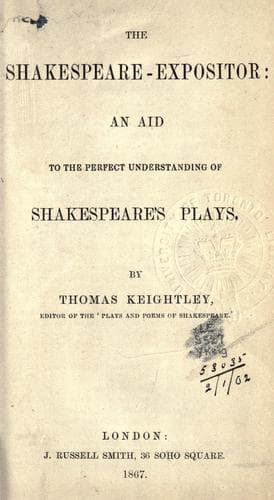
The Shakespeare-Expositor: An Aid to the Perfect Understanding of Shakespeare's Plays — John Shaqi
The Shakespeare-Expositor: An Aid to the Perfect Understanding of Shakespeare's PlaysKeightley, Thomas
General
The Shakespeare-Expositor: An Aid to the Perfect Understanding of Shakespeare's Plays
Keightley, Thomas
Drama -- Outlines, syllabi, etc.; Shakespeare, William, 1564-1616 -- Outlines, syllabi, etc.
_Date._ From the Accounts of the Revels, we learn that this play was
performed at Court, November 1st, 1604; and if the Egerton Papers,
published by Mr. Collier, can be relied on, it had been performed
before Queen Elizabeth. In them we meet as follows:--"6 August, 1602.
Rewards to the vaulters, players, and dancers--of this x^{li} to
Burbidge's players for Othello--lxiiii^{li} xviii^{s} x^{d}." "The
part of the memorandum which relates to Othello," says Mr. Collier,
"is interlined as if added afterwards." Mr. Halliwell asserts that
Othello must have been written even before 1600; for in a MS. of that
date, entitled The Newe Metamorphosis, &c., is a passage evidently, he
thinks, imitated from "who steals my purse steals trash" in Othello.
But, though Mr. Halliwell thinks otherwise, this passage may have been
a later insertion; or it may be a mere coincidence, a thing much more
common than is usually supposed. At all events Othello was written,
at latest, in 1604. I know not if it has been observed that Voltaire
evidently had Othello in his mind when writing his Zaïre.
_Origin._ The only known source of this play is a tale in the
Hecatommithi of Cinthio; and as no English translation of it is known
to have existed, the obvious and natural inference is that Shakespeare
had read it in the original. There was, however, it seems, a French
translation: Paris, 1584.
JULIUS CÆSAR.
_Edition._ Only in the folio, 1623.
_Date._ The real date of this play is very uncertain, and I am very
dubious whether I am right or not in giving it this position. Mr.
Collier--with whom Mr. Dyce agrees--is positive that it appeared before
1603, for in that year Drayton published his Barons' Wars, in which is
a passage so like the character of Brutus given in this play (v. 5),
that one poet must have borrowed from the other; and it is inferred
of course that Drayton was the borrower. But this is not by any means
so certain, as the eagle did not always disdain to take a plume from
the smaller birds (see above, The Two Gentlemen of Verona). It is very
strange, however, that neither of these critics seems to have been
aware that the very same ideas, and even expressions, are to be found
in the character given of Crites in Ben Jonson's Cynthia's Revels
(ii. 1), which was performed in 1600, and which may therefore I think
justly be regarded as the real immediate original of the passages in
both poets; the germ, however, is to be found in Chaucer's Tale of
the Doctor of Physik. All, then, that we can venture to affirm is,
that Julius Cæsar is posterior to 1600. I incline to place it in
point of time before Shakespeare's other plays on Roman subjects. It
may be observed that his Antony and Cleopatra and Coriolanus are as
much Histories as those that are so entitled, the history being Roman
instead of English.
_Origin._ North's Plutarch, from the French of Amyot.
ANTONY AND CLEOPATRA.
_Edition._ Only in the folio 1623.
Public-domain text, read in full here on John Shaqi.
Reviews
Reviews
No reviews yet
Be the first to share your thoughts on this work.
Join the Discussion
Join the discussion
Sign in to leave a comment or review.
Sign InorCreate an account