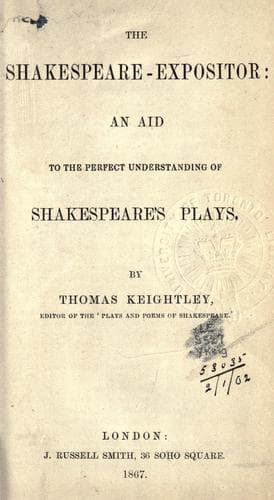
The Shakespeare-Expositor: An Aid to the Perfect Understanding of Shakespeare's PlaysKeightley, Thomas
General
The Shakespeare-Expositor: An Aid to the Perfect Understanding of Shakespeare's Plays
Keightley, Thomas
Drama -- Outlines, syllabi, etc.; Shakespeare, William, 1564-1616 -- Outlines, syllabi, etc.
To me _most_ fatal, me most it concerns.
Par. Reg. iv. 205: Todd's 4th edit.
Here, again, the true reading is _so_; yet, as _most_ makes good
sense, if the error had been in the original edition it would in all
probability never have been detected. Opening by chance Bloomfield's
pretty poem of The Farmer's Boy (ed. 1857), I met with
Till when up-hill the destined _hill_ he gains.
Winter, 173.
We may find in Chaucer--
What ladies fairest ben or best _dauncing_,
Or which of hem can _daunce_ best or sing.
Knt's Tale.
Here for _dauncing_ we should probably read _loking_.
Of his _gladnesse_ he _gladed_ her anone.
Tr. and Cr. i.
The poet probably wrote _goodnesse_.
For though a man _forbide_ drunkenesse,
He not _forbides_ that every creature
Be drunkeles for alway, as I gesse.
Ib. ii.
We should read _commaundes_ in the second line.
Witness the daily libels _almost_ ballads
In every place, _almost_ in every province,
Are made upon your lust.
Thierry and Theodoret, i. 1.
We should for the first _almost_, which must be wrong, probably read
_and the_. Mr. Dyce seems never to have seen this; for he had no
conception of this source of error: yet I wonder common sense did not
suggest that something must be wrong.
The things that grievous were to do or bear
Them to renew, I wote, breeds no delight;
Best music breeds _delight_ in loathing ear.
F. Q. i. 8. 44.
For _delight_ in the last line we might read _dislike_, but I think
we should rather read _annoy_; for in these cases, as we may see, no
resemblance in form or sound is to be sought. I therefore in Othel.
iii. 3, reject the emendation of Pope and 4to 1630 of _feels_ for
_keeps_, because it was evidently suggested by the slight similarity of
form, and does not perfectly suit the context. The reader will find an
excellent instance in As You Like It, ii. 3.
My news shall be the _news_ to that great feast.
Ham. ii. 2.
So the folio reads; the 4to has more correctly _fruit_.
Surely Shakespeare never wrote
To seek thy _help_, by beneficial _help_.
Com. of Err. i. 1.
He that they cannot _help_ him,
They that they cannot _help_.
All's Well, i. 3.
Public-domain text, read in full here on John Shaqi.
Reviews
Reviews
No reviews yet
Be the first to share your thoughts on this work.
Elsewhere in the archive
Join the Discussion
Join the discussion
Sign in to leave a comment or review.
Sign InorCreate an account