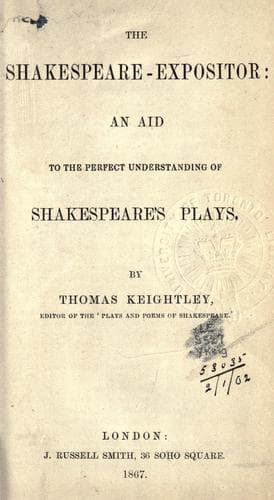
The Shakespeare-Expositor: An Aid to the Perfect Understanding of Shakespeare's PlaysKeightley, Thomas
General
The Shakespeare-Expositor: An Aid to the Perfect Understanding of Shakespeare's Plays
Keightley, Thomas
Drama -- Outlines, syllabi, etc.; Shakespeare, William, 1564-1616 -- Outlines, syllabi, etc.
As this error _never_ occurs in Jonson and Massinger, and only, I
believe, in the instance given above in Beaumont and Fletcher, and has
no æsthetic advantage or beauty to recommend it, it seems quite absurd
to suppose that Shakespeare, whose vocabulary was the largest of all,
and whose ear was so fine and correct, should have found pleasure in
it. Surely a just critic will sooner lay the blame on the printer and
the careless editors, very different in this respect from those of
Beaumont and Fletcher, who seem never to have hesitated to correct an
error when they discovered it.
The resemblance in form above alluded to is of great importance, under
the name of _ductus literarum_, in the eyes of Mr. Dyce, and it should
always be attended to; for it is usually caused by the attempt of the
printer to make out illegible writing. The following are striking
instances:--
In Peele's Edward I. these lines occur.
To calm, to qualify, and to compound,
_Thank England's_ strife of Scotland's climbing peers.
That the last line is nonsense was clear to every one; but no critic
ever could emend it. The true reading, however, is doubtless _The
enkindled_, which flashed suddenly on my mind one time when I was
considering the passage. It was probably the resemblance of sound
chiefly that misled the printer.
At the end of Marston's Insatiate Countess we meet the following
unmeaning line,
Like _Missermis_ cheating of the _brack_,
which Steevens corrected most happily thus--
Like _Mycerinus_ cheating of the _oracle_,
having discerned the allusion to Herod. ii. 133.
It is very curious that the word substituted is often the very
opposite of the right word. I myself once wrote--and so it is
printed--_diameter_ for _circumference_. In Mrs. C. Clarke's most
valuable Concordance we have "humorous _plebeian_" for "humorous
_patrician_." I have met with _next_ for _last_ and _none_ for _some_;
so in The Mer. of Ven., ii. 2, where the folio has "Is sum of
_no_thing," the 4tos read "Is sum of _some_thing." In Lear v. 3, the
folio reads
The gods are just, and of our pleasant _vices_
Make instruments to plague us;
while the 4tos have "pleasant _virtues_."
In All's Well, iii. 2, and Taming of the Shrew, iii. 1, we have _old_
for _new_. In a proof-sheet which I lately saw there was a quotation of
The paths of glory lead but to the grave;
and the printer had substituted _life_ for "grave," though, as the
entire stanza was given, he had the rime to guide him. Many instances
of this practice will be found in Love's Labour's Lost. In La
Giovanezza, a poem of the Italian poet Pindemonte, I have just met with
_brutte_ where the rime and the sense require _belle_.
Public-domain text, read in full here on John Shaqi.
Reviews
Reviews
No reviews yet
Be the first to share your thoughts on this work.
Elsewhere in the archive
Join the Discussion
Join the discussion
Sign in to leave a comment or review.
Sign InorCreate an account