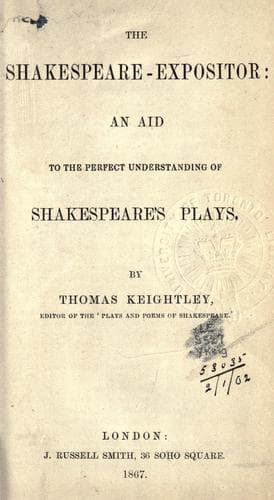
The Shakespeare-Expositor: An Aid to the Perfect Understanding of Shakespeare's PlaysKeightley, Thomas
General
The Shakespeare-Expositor: An Aid to the Perfect Understanding of Shakespeare's Plays
Keightley, Thomas
Drama -- Outlines, syllabi, etc.; Shakespeare, William, 1564-1616 -- Outlines, syllabi, etc.
It does not seem to have been observed that printers will actually
insert words, for the sake of sense or metre, when they have made a
mistake. In my Life of Milton, I had occasion to quote a passage from
his prose works containing "with a conscience that would _retch_;" and
of this the printer made "with a conscience that _he_ would _relish_;"
and so, I am sorry to say, it is printed. See on Mer. of Ven. iv. 1.
And stones did cast, yet he for nought would swerve.
F. Q. v. 12. 43.
As the rimes are _deserved_, _preserved_, _observed_, the poet must
have written _e'er swerved_ or _nothing swerved_.
In her right hand a fire-brand she _did toss_.
F. Q. iii. 12, 17.
The rimes are _embost_, _lost_, so that Spenser must have written
_tost_, making, as usual, a dissyllable of _fire_. That it was not the
poet himself that made the mistake is clear; for in
Till Arthur all that reckoning defrayed (ii. 10, 49)
the edition of 1750 has _did defray_.
A contrary error to this is where the printer has made one word of two,
caused either by sound or by illegible writing. For instances, see
on Com. of Err. iii. 1, Tw. Night, i. 1, Mer. Wives, v. 5, Ant. and
Cleop. iv. 9, Macb. iii. 4.
The fact of effacement in the manuscript, on which I have laid
such stress in the section on _Omission_, has also been a cause of
substitution; for, the original word having become nearly or totally
illegible, the transcriber or compositor, in order to make sense, used
to give some term of his own. Thus we have _yes_ for _I will_, Meas.
for Meas. iii. 1, _yea_ for _even so_, Rich. II. iii. 1, _ay_ for _I
will_, Ham. iv. 7, as is proved by the metre. These are all at the
beginning of the line, and hence their liability to effacement. See
also on All's Well, ii. 1, Twelfth Night, iv. 3, Rich. II. i. 3, and
elsewhere.
Finally, substitutions are often quite capricious, making no sense
whatever. For "he went circuit," where my manuscript was perfectly
legible, I once got "_the local_ circuit;" so also "_the merits_"
for "there an echo;" "_establishment_" for "established government."
In Alison's Life of Lord Castlereagh, one of the pall-bearers at
the funeral of the Duke of Wellington was Sir Peregrine _Pickle_
(Maitland); in all editions of Joseph Andrews we have in one place "Sir
_John_" for "Sir Thomas" Booby.
Public-domain text, read in full here on John Shaqi.
Reviews
Reviews
No reviews yet
Be the first to share your thoughts on this work.
Elsewhere in the archive
Join the Discussion
Join the discussion
Sign in to leave a comment or review.
Sign InorCreate an account