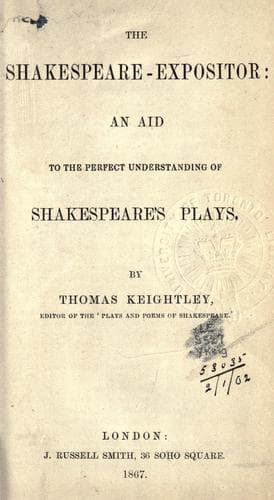
The Shakespeare-Expositor: An Aid to the Perfect Understanding of Shakespeare's PlaysKeightley, Thomas
General
The Shakespeare-Expositor: An Aid to the Perfect Understanding of Shakespeare's Plays
Keightley, Thomas
Drama -- Outlines, syllabi, etc.; Shakespeare, William, 1564-1616 -- Outlines, syllabi, etc.
It is to be observed that _to unto_, _till until_, _on upon_, _though
although_, _e'er ever_, &c., were frequently confounded. It is
therefore the merest printer-worship to hesitate at altering them
when the metre requires it. A further observation is, that even down
into the eighteenth century, it was the custom to write _y_ for _th_
in monosyllables beginning with this last (þ, A. S.), as y^{e} the,
y^{n} then, y^{t} that, y^{u} thou; y^{r} your was another abridgment;
and hence confusion has often arisen. In these plays we have _that_
for _then_ in four places (see on Tr. and Cr. i. 2); and in Paradise
Regained (i. 137) we have _then_ for _thou_, and also, I think, in Tw.
Night, v. 1.
11.
Such, then, are the various sources of error in the original editions
of Shakespeare's plays, the correction of which and restoration of the
poet's real sense are, as I have said, the task of the genuine critic,
and one in which, except in a very few instances, success is not to be
by any means despaired of.
As a means of obtaining it, I would, as I have done, lay it down
as a rule that no word or phrase should be employed in restoration
which is not to be found in the poet's own works, or at least in
those of his contemporaries. It is obvious that by so doing we shall
greatly diminish the risk of failure. It is a curious fact, that not
unfrequently two or even three corrections are so equally good, that
it is exceedingly difficult to choose between them, and that the final
choice thus becomes a matter of mere chance. In such cases I think the
critic should select the one which is the most poetic and most worthy
of the poet. The coincidence of two or more independent critics in a
correction is, in general, a proof of its truth; yet even this is not
infallible. See on Merry Wives, ii. 3.
For correction, then, the first requisite is a thorough knowledge of
the poet's language, the acquisition of which is a work demanding
both time and close attention. Shakespeare's vocabulary, as we have
seen, is extremely copious, and from his not having had the advantage
of a regular education his plays present more anomalies, and offer
more difficulties to the modern reader than those of the contemporary
dramatists.
In his early pieces there is an incessant play on words; and in
his later the language is often very elliptical and the sentences
greatly involved. These difficulties are enhanced by the ignorance of
punctuation, or neglect of it, with which the editors are chargeable.
Thus it is only in very plain cases that they notice the break in sense
caused by the aposiopesis, the anacoluthon, or an interruption, of
which the reader will find so many examples in my Edition and in the
following pages, marked for the first time, and designated by the sign
(...). I would particularly direct his attention to Temp. iii. 1, 2
Hen. IV. iv. 1, Ham. i. 2, i. 4.
12.
In the dramas and other works of those days we may observe the
following peculiarities.
Public-domain text, read in full here on John Shaqi.
Reviews
Reviews
No reviews yet
Be the first to share your thoughts on this work.
Elsewhere in the archive
Join the Discussion
Join the discussion
Sign in to leave a comment or review.
Sign InorCreate an account