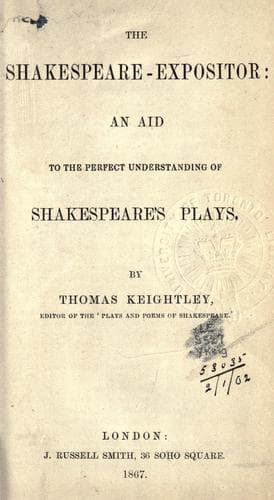
The Shakespeare-Expositor: An Aid to the Perfect Understanding of Shakespeare's PlaysKeightley, Thomas
General
The Shakespeare-Expositor: An Aid to the Perfect Understanding of Shakespeare's Plays
Keightley, Thomas
Drama -- Outlines, syllabi, etc.; Shakespeare, William, 1564-1616 -- Outlines, syllabi, etc.
The infinitive mood is used with or without _to_ differently from the
present usage--prefixed where we omit, omitted where we prefix. It is
also employed, like the Hebrew infinitive absolute, where we use the
present participle active, sometimes with a preposition, _ex. gr._,
Copious in words, and one that much time spent
_To jest_.
Lydgate, Book of Troy.
Even in Cowley we meet with
The sun himself, although all eye he be,
Can find in love more pleasure than _to see_.
The Gazers.
Here it is plain we should use the participle _in seeing_.
In "He is grown too proud to be so valiant," Cor. i. l, "to be" seems
to be _i. q._ being; _too_ being apparently used in the sense of
_trop_, Fr., _i.e._ excessively.
The passive participle was continually used in the place of the present
or past participle active or of the future. Chapman, for instance, is
profuse in his use of it in his Homer. Of this, as of the former, we
have some remains among us still, but few indeed compared with what our
forefathers had. The perfect was also frequently used as a part. past,
and of this also we have still some remains.
In imitation of the Latin and French, the writers of the sixteenth
century--for we do not meet with it in Chaucer or Gower--used the verb
as a noun, as _dispose_ for _disposal_, _suspect_ for _suspicion_.
A further peculiarity was the use of what grammarians call collectives,
_i.e._, the singular noun used for the plural. We still retain this
in _sheep_, _swine_, _fowl_, and partially in _year_, _day_; but in
our older writers we meet with it in _horse_ (Much Ado, i. 1, Hen. V.
iv. 1, and in Chapman's Homer continually), _pearl_ (Macb. _ad fin._),
_tree_, _corpse_, _witness_, _business_, _subject_, _princess_ (Temp.
i. 2), and other words.
Writers of those days--and Shakespeare more than any--were fond of
using verbs in a causative sense, as _fall_ for cause to fall, let
fall, _fear_ for make fear. In these plays we meet, in a causative
sense, with _cease_, _linger_, _neglect_, _silence_, _faint_, _perish_,
&c. Thus _learn_ became _teach_, _take give_. It is only thus that
"_smiles_ his cheek in years" (L. L. L. v. 2) becomes sense.
13.
There was a peculiarity of the grammar of those days which is now
confined to the vulgar, namely, that of joining a plural nominative
with a singular verb, _ex. gr._,
That in this spleen ridiculous _appears_,
To check their folly, passions solemn _tears_.
L. L. L. v. 2.
Public-domain text, read in full here on John Shaqi.
Reviews
Reviews
No reviews yet
Be the first to share your thoughts on this work.
Elsewhere in the archive
Join the Discussion
Join the discussion
Sign in to leave a comment or review.
Sign InorCreate an account