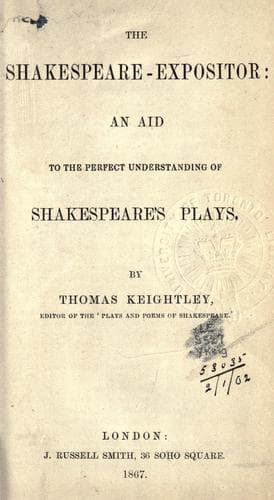
The Shakespeare-Expositor: An Aid to the Perfect Understanding of Shakespeare's PlaysKeightley, Thomas
General
The Shakespeare-Expositor: An Aid to the Perfect Understanding of Shakespeare's Plays
Keightley, Thomas
Drama -- Outlines, syllabi, etc.; Shakespeare, William, 1564-1616 -- Outlines, syllabi, etc.
The rimes here and in several other places prove that this is no
printer's error; and this construction is actually most frequent in
Peele, Marston, and Fletcher--all University men! Editors, Mr. Dyce for
example, are in the habit of taking the most unwarrantable liberty of
altering this construction, except where restrained by the rimes. This
practice is highly reprehensible and should be avoided; for we should
give the text as it came from the poet's pen.
The origin of this structure is very simple. In the Anglo-Saxon the
verbs made their plural in _th_, not in _n_, as afterwards became the
usage. This plural of the verb occurs continually in the Vision of
Piers Ploughman, and we find it not unfrequently even in the State
Papers of the early Tudor period, in its later form; for, as in the
singular, the _th_ was gradually changed to _s_.
In the more artistic compositions of Chaucer and Gower, however, it is
very rare. The following line in Chaucer,
As _flakès fallès_ in grete snowes,
House of Fame.
shows that even in his time the _th_ had been converted into _s_. The
present practice, then, we may see is merely a change of fashion, and
our ancestors' mode of forming the plural was perfectly correct and
grammatical, with one exception--of which we still meet instances--that
of using _is_ and _was_ as a plural. In my Edition of our poet's plays,
I have therefore very generally preserved this structure; for we may
alter orthography and punctuation, but not grammar.
On the other hand, I must maintain, in opposition to Mr. Dyce, that
the union of a single noun with a plural verb was _never_ a rule of
the language, but _always_ an error of the copyist, or a slip of the
writer. Of this I can give positive instances.
I one day met in my own History of England the following words, "The
_blood_ of Catesby and two others alone _were_ shed;" and on looking
at the first edition I found of course that my word had been _was_.
In Mr. Lloyd's Critical Remarks on Measure for Measure, in Singer's
Shakespeare, we may read "the five _acts_ of the first part of Promos
and Cassandra _concludes_ the iniquity of the deputy." Nor is this
confined to English; in the Gerusalemme Liberata, and unnoticed by any
editor, we find
Non si conviene a te, cui fatto _il corso_
Delle cose e de' tempi _han_ si prudente.--x. 41.
In all cases it will be found to be the consequence of a noun of a
different number having intervened between the nominative and the verb.
Mr. Dyce, however, tries to make a rule of it by saying that "our early
writers" did it when a genitive plural intervened; but that will not
apply to passages like these--
Whose _youth_, like wanton boys through bonfires,
_Have_ skipt thy flame.--Two Noble Kinsmen, v. 1.
Public-domain text, read in full here on John Shaqi.
Reviews
Reviews
No reviews yet
Be the first to share your thoughts on this work.
Elsewhere in the archive
Join the Discussion
Join the discussion
Sign in to leave a comment or review.
Sign InorCreate an account