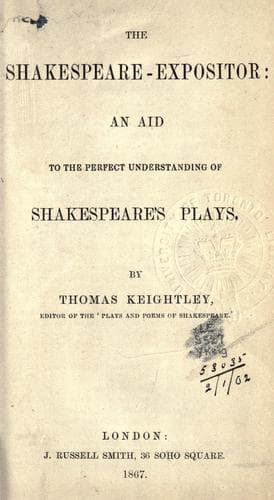
The Shakespeare-Expositor: An Aid to the Perfect Understanding of Shakespeare's PlaysKeightley, Thomas
General
The Shakespeare-Expositor: An Aid to the Perfect Understanding of Shakespeare's Plays
Keightley, Thomas
Drama -- Outlines, syllabi, etc.; Shakespeare, William, 1564-1616 -- Outlines, syllabi, etc.
_The sea_,
With his proud mountain-waters envying heaven,
When I say 'still!' _run_ into crystal mirrors.
Valentinian, iv. 1.
Of others' voices, that my adder's _sense_,
To critic and to flatterer stopped _are_.
Shakespeare, Son. cxii.
This last is the error of the poet, who probably had _ears_ in his
mind; yet _sense_ may be a collective: all the others are perhaps to be
ascribed to the original printers.
The intensive particle _be_ was prefixed to verbs much more frequently
than at present. There was also a frequent ellipsis of the first
personal pronoun before such verbs as _cry_, _beseech_, _beshrew_, &c.;
and finally the habit--still retained by the vulgar--of cutting away
the first syllable of a word prevailed to some extent.
14.
The pronunciation of Shakespeare's time of course differed in many
points from that of the present day. Thus _aspect_ and many other
words were accented, and properly, on the last syllable; we also
have _obdúrate_, _árchbishop_, _cónfessor_, &c. In words such as
_case_, _pace_, _lace_, the French sound of the _a_ seems to have
been partially retained--Chaucer writes these words _cas_, _caas_,
_paas_, _laas_--along with the ordinary English sound. Chaucer also
writes 'made' _maad_, Raleigh 'safe' _sauf_; and as the Master of the
Revels wrote Shakespeare's name _Shaxberd_, we may suppose that _shake_
and terms of a similar form were pronounced _shak_, &c. If we do not
pronounce _lac'd_ as _last_ in "lac'd mutton" (Two Gent. i. 2), we lose
the humour of the passage. When Spenser therefore makes _prepar'd_,
for example, rime with _hard_, he was probably doing nothing very
unusual; for these double sounds--as we may see by the example of _shew
show_, _shrew shrow_, _lese lose_--were by no means uncommon. I suspect
that _sea_ may have been one of these, and that besides riming with
_see_, as indeed Chaucer always writes it, it retained the sound of
the Anglo-Saxon [sæ]; for F. Beaumont in his Poems almost invariably
makes it rime with such words as _day_, _lay_, _ray_. Waller, followed
by Pope, Gay, and other poets, most improperly made _ea_ rime with
_ai_, _ay_, as _tea_ with _obey_, &c. As _haste_, _chaste_, _waist_,
&c, constantly rime with _fast_, _last_, &c, they were probably, I
think certainly, pronounced as they were written, like them; or they
may have had a double pronunciation like the words just quoted. As
the more usual orthography was _chaunge_, _raunge_, &c, these words
would seem to have been pronounced as in French, and as we still
pronounce _daunt_, _haunt_, _avaunt_. In words chiefly from the French,
terminating in _ci_, _si_, _ti_ followed by a vowel, as in _nation_,
_fashion_, _passion_, &c.--to which we may add _ocean_--the usual sound
was _s_, not _sh_ as at present. On the whole, the language seems to
Public-domain text, read in full here on John Shaqi.
Reviews
Reviews
No reviews yet
Be the first to share your thoughts on this work.
Elsewhere in the archive
Join the Discussion
Join the discussion
Sign in to leave a comment or review.
Sign InorCreate an account