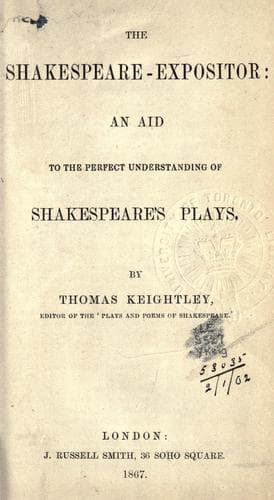
The Shakespeare-Expositor: An Aid to the Perfect Understanding of Shakespeare's PlaysKeightley, Thomas
General
The Shakespeare-Expositor: An Aid to the Perfect Understanding of Shakespeare's Plays
Keightley, Thomas
Drama -- Outlines, syllabi, etc.; Shakespeare, William, 1564-1616 -- Outlines, syllabi, etc.
have been more euphonious than that of the present day.
While on the subject of euphony, I must direct attention to one point.
Our ancestors probably pronounced _my_, _thy_ (mín, þín, A.-S.), _mee_,
_thee_, with a short sound also, when not emphatic, as in _by_, _to_,
&c. Owing to its falling out of familiar use, and its employment in
the Bible and Liturgy, _thy_ has long--except by the Quakers and the
peasantry--been pronounced so as to rime with _fly_, _try_; but _my_
retained its proper sound till within the last few years; Walker, for
instance, knew nothing of a change. But now our ears are constantly
dinned with an egotistic _my_ like _thy_. I mention this because this
new-fangled pronunciation is ruinous to both euphony and humour in our
elder writers.
I shall conclude with some remarks upon _its_, a word of which
Shakespeare may almost be regarded as the originator; though Spenser,
no doubt, had used it _once_ (F. Q. vi. 11. 34) before him. Singer
says it "occurs but twice or thrice" in Shakespeare; and Archbishop
Trench and others say "three or four times;" while the fact is that its
occurs _twelve_, and _it_, as a genitive, no less than _fifteen_ times.
We meet _its_ only nine times in the numerous plays of Beaumont and
Fletcher, and but half a dozen times in those of Jonson or Massinger.
The Chinese language makes the genitive by merely prefixing the
substantive; thus _houe jin_ (_houe_ kingdom) is "man of the kingdom."
The same is the structure of the Teutonic and Scandinavian languages,
ex. gr., _day light_, &c.; but while all the others make the two
substantives form one word, the English sometimes keeps them separate,
sometimes unites them by a hyphen, and at other times makes them into
one word. Hence we may observe, by the way, that it is needless, as
well as cacophonous, to add an '_s_ to a substantive ending in that
letter; even the simple turned comma is superfluous, the position alone
indicating its genitive sense.
It appears that not only nouns but pronouns were so employed. In the
first page of the Canterbury Tales we have--
And bathed every veyne in swich licour,
Of _which_ vertue engendred is the flour.
Here _which_ is a genitive, for which we should now use _whose_ (the
genitive of _who_), a pronoun that our forefathers used of things as
well as persons.
In like manner, though _his_ was the usual genitive of _it_ as well as
of _he_, it was not uncommon to make the genitive by simply prefixing
_it_, as in
Lord, how it could so prettily have prated with _it_ tongue!
Romeus and Juliet, 1562.
and other passages. I do not think it ever occurs in Chaucer, Gower, or
Piers Ploughman.
Public-domain text, read in full here on John Shaqi.
Reviews
Reviews
No reviews yet
Be the first to share your thoughts on this work.
Elsewhere in the archive
Join the Discussion
Join the discussion
Sign in to leave a comment or review.
Sign InorCreate an account