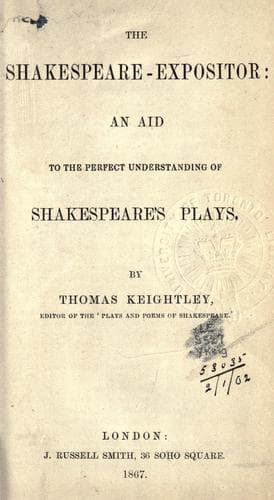
The Shakespeare-Expositor: An Aid to the Perfect Understanding of Shakespeare's PlaysKeightley, Thomas
General
The Shakespeare-Expositor: An Aid to the Perfect Understanding of Shakespeare's Plays
Keightley, Thomas
Drama -- Outlines, syllabi, etc.; Shakespeare, William, 1564-1616 -- Outlines, syllabi, etc.
I am therefore of opinion that Shakespeare may be regarded as the chief
agent in introducing _its_ into the language. It is to be noticed that
it never occurs in the Bible, only thrice, or rather only twice, in
Milton, and but once in Waller. Chatterton used it twice in the very
first page of his Poems of Rowley; yet the critics of the time did not
discern this plain proof of forgery!
On the disputed question of the use of _his_ for the genitive, I
will only observe that the fact is that the preceding noun is used
absolutely. Thus, as we have "The king, he is hunting the deer," so we
have "the king, his palace." The same structure precisely is to be met
with in Dutch and German--we meet with it, for instance, in Schiller's
Wallenstein; and Captain Burton informs us that in the Kariri language
of Eastern Africa, "The Kazi's brother," for example, is _Kazi-ih-zo_,
literally "The Kazi, his brother."
II. THE VERSE.
15.
Chaucer introduced into English poetry the iambic verse of five feet,
formed by the Provençals in imitation of the Classic Phaleucian and
Sapphic hendecasyllables, and adopted from them by the Italian poets.
These last, however, though they held the principle of admitting but
five _ictus_ in a line, did not limit themselves to eleven syllables,
as the following examples will show:--
Che passa i monti, e rompe i muri e l'armi.
Dante, Inf. xvii. 2.
L'oro, e le perle, e i fior vermigli, e i bianchi.
Petr. Son. xxxi.
Non danno i colpi, or finti, or pieni, or scarsi.
Tasso, Ger. Lib. xii. 55.
So the Greeks in their dramatic iambics admitted trisyllabic feet,
Æschylus admitting one foot, Sophocles two, Euripides three; while the
comic poets, both Greek and Latin, used these feet still more freely,
not, however, exceeding the limit of three.
Chaucer did not allow himself the same licence as his masters. He
sometimes admits one such foot, rarely two, and three, I believe, only
once. He also uses at times the Alexandrine or verse of six feet.
The first who used this verse for the drama in England was Bishop Bale,
who in 1538 published three Interludes, as he termed them, or dramatic
pieces on Scriptural subjects. Here are a few lines from the one named
God's Promises:--
In the begynnynge, before the heavens were create,
In me and of me was my sonne sempyternall,
With the Holy Ghost, in one degre or estate
Of the hygh godhed, to make the Father coequall,
And thys my Sonne was with me one God essencyall,
Without separacyon at any tyme from me,
True God he is of equall dignytè.
The feet, it will be seen, are here of two or three syllables
indifferently; and the same is the case in the couplets which occur
also in these plays.
Public-domain text, read in full here on John Shaqi.
Reviews
Reviews
No reviews yet
Be the first to share your thoughts on this work.
Elsewhere in the archive
Join the Discussion
Join the discussion
Sign in to leave a comment or review.
Sign InorCreate an account