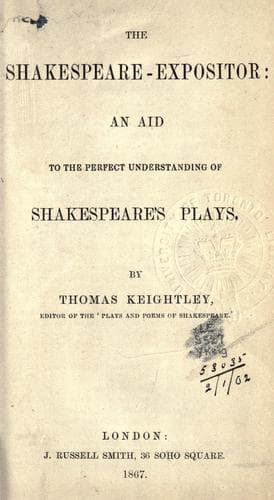
The Shakespeare-Expositor: An Aid to the Perfect Understanding of Shakespeare's PlaysKeightley, Thomas
General
The Shakespeare-Expositor: An Aid to the Perfect Understanding of Shakespeare's Plays
Keightley, Thomas
Drama -- Outlines, syllabi, etc.; Shakespeare, William, 1564-1616 -- Outlines, syllabi, etc.
About the same time Nicholas Udall wrote his comedy of Ralph Roister
Doister--not printed till 1566--in which we have the earliest specimen
of the verse afterwards chiefly used for comedy, namely, one of four
feet, the foot of two, three, and even four syllables. It commences
thus:--
As long lyveth the mery man (they say)
As doth the sory man, and longer by a day,
Yet the Grassehopper for all his Sommer pipyng
Sterveth in Winter wyth hungrie gripyng.
This measure may be seen in Damon and Pitheas, New Custom, Gammer
Gurton's Needle, and other plays, in which we shall find it admitting
lines of five and even six and seven feet,--_ex. gr._,
That state is most miserable. Thrise happy are we
Whom true love hath joined in perfect amity.
Which amity first sprung, without vaunting be it spoken that is true,
Of likeliness of manners, took root by company, and now is
conserved by virtue.--Damon and Pitheas.
Contemporary with Bale and Udall, the illustrious Earl of Surrey had
introduced into English a new species of verse--blank verse. This was a
five-foot iambic measure without rime, and admitting of verses of six
feet. His version of two books of the Æneis in this measure was printed
in 1557; and five years later, Jan. 18, 1561-2, a play written in it
and named Gordebuc, by Norton and Sackville, was performed before Queen
Elizabeth at Whitehall, and it was given to the press in 1566. But more
than twenty years elapsed before blank verse made its first appearance
on the public stage in the Tamburlain of Marlow. From its inherent
superiority, it at once became the established form for the drama,
still mingled, however, with riming couplets and stanzas.
16.
I have already expressed my opinion that the earliest among the extant
dramas of Shakespeare _may_ have been The Comedy of Errors. This is
in blank verse, in general strictly decasyllabic, mingled with the
riming measures above noticed. His next play would seem to have been
The Two Gentlemen of Verona, much of the same form, but differing from
it, and from its immediate successors, by admitting in its blank verse
trisyllabic feet, as in
A virtuous gentlewoman, mild and beautiful.--iv. 4.
It might seem as if the poet were hesitating about the adoption of a
freer kind of verse such as came afterwards into use. Love's Labour's
Lost, and the other plays in Meres' list--to which, as may be seen,
The Taming of the Shrew is to be added--are all of the same kind. As
he advanced in his career, he gradually discarded rime, and admitted
the trisyllabic foot more frequently. He also learned to run his verses
into each other, thus forming a system; the preposition, for instance,
ending one line, and the word it governed beginning the next line.
Public-domain text, read in full here on John Shaqi.
Reviews
Reviews
No reviews yet
Be the first to share your thoughts on this work.
Elsewhere in the archive
Join the Discussion
Join the discussion
Sign in to leave a comment or review.
Sign InorCreate an account