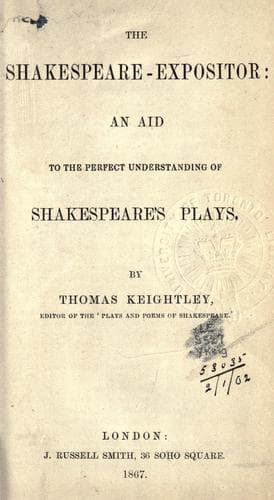
The Shakespeare-Expositor: An Aid to the Perfect Understanding of Shakespeare's PlaysKeightley, Thomas
General
The Shakespeare-Expositor: An Aid to the Perfect Understanding of Shakespeare's Plays
Keightley, Thomas
Drama -- Outlines, syllabi, etc.; Shakespeare, William, 1564-1616 -- Outlines, syllabi, etc.
The blank verse of Surrey and of the authors of Gordebuc--admitting,
as we have seen, verses of six feet--may be regarded as strictly
decasyllabic. But when it became the standard verse of the theatres it
gradually relaxed from its strictness, and admitted trisyllabic feet
more and more as it advanced, so that in Fletcher we actually meet
with lines containing fifteen syllables, though of no more than five
feet. It is most strange that, with these facts staring them, as I
may say, in the face, editors, almost without exception, seem to have
been haunted by a spectre of five decasyllabic feet. "How often," says
Gifford, "will it be necessary to observe that our old dramatists never
counted their syllables on their fingers!" They also seem to be unaware
of the existence of Alexandrines, or verses of six feet. The play of
Othello, for instance, is as full of them as Dryden's riming couplet
verse; and yet Mr. Dyce--whom I generally notice as being usually
regarded as a leading critic--writes frequently as if such a line were
not admissible in dramatic verse.
Again, there are critics who regard a verse as good if it contains ten
syllables, no matter how made or how arranged.
Thus Malone gives as good verses,
What wheels, racks, fires, flaying, boiling.--W. T. iii. 2.
Curs'd be I that did so. All the chärms.--Temp. i. 2.
Poürs into captains' wounds? banishment.--Timon, iii. 5.
Mr. Collier regards as a good verse,
To yond generation you shall find.--M. for M. iv. 3.
"Doth comfort thee in _thy_ sleep. Live and flourish" is the usual
reading in Rich. III. v. 5; mine is at least more euphonious.
It has never to my knowledge been sufficiently noticed that Shakespeare
makes occasional use of the seven-foot verse of Golding's Ovid
and Phaer's Virgil, works in which it is evident he was extremely
well-read. Such are the following lines:--
For often have you writ to her, and she in modesty,
Or else for want of idle time, could not again reply;
Or fearing else some messenger, that might her mind discover,
Herself hath taught her love himself to write unto her
lover.--Two Gent. ii. 1.
A cherry-lip, a bonny eye, a passing-pleasing tongue.
Rich. III. i. 1.
My visor is Philemon's roof; within the house is Jove.--
Why then your visor should be thatch'd.--
Speak low, if you speak love.--Much Ado, ii. 1.
Convey the wise it call: steal! foh! a fico for the phrase!--
Well, sirs, I am almost out at heels.--
Why, then, let kibes ensue.--Mer. Wives, i. 3.
As many devils entertain, and To her, boy! say I.--Ib.
Thou art the Mars of malcontents. I follow thee, troop on.
Ib.
Die men like dogs; give crowns like pins; have we not Hiren
here?--2 Hen. IV. ii. 4.
Public-domain text, read in full here on John Shaqi.
Reviews
Reviews
No reviews yet
Be the first to share your thoughts on this work.
Elsewhere in the archive
Join the Discussion
Join the discussion
Sign in to leave a comment or review.
Sign InorCreate an account