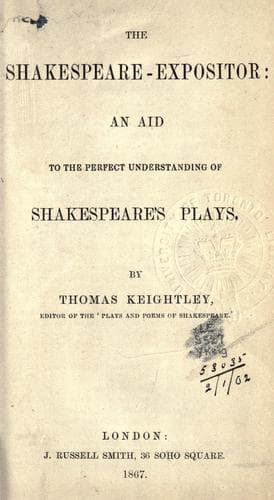
The Shakespeare-Expositor: An Aid to the Perfect Understanding of Shakespeare's PlaysKeightley, Thomas
General
The Shakespeare-Expositor: An Aid to the Perfect Understanding of Shakespeare's Plays
Keightley, Thomas
Drama -- Outlines, syllabi, etc.; Shakespeare, William, 1564-1616 -- Outlines, syllabi, etc.
This, perhaps the only imprudent act of Shakespeare's life, has been
variously judged. Nothing, we know, is more common than for young men
to fall in love with women older than themselves; and among the class
of society to which both parties belonged, instances were, and are,
not uncommon of the rules of prudence being transgressed in moments of
weakness, while the moral principle remains untainted. We know that
Burns's "Bonnie Jean" proved a most exemplary wife; and one of the
most truly virtuous and unaffectedly modest women I ever knew was one
who had acted thus imprudently. The bride of the future poet was Anne,
daughter of Richard Hathaway, a husbandman, or substantial yeoman, of
Shottery, a hamlet about a mile from Stratford, an intimate friend, it
would appear, of John Shakespeare's; and hence we may presume that an
intimacy prevailed also between the two families, and the not unlikely
result was what has been stated.
We now have Shakespeare, at the commencement of his twentieth year,
a married man, and the father of a child. On the 2nd of February,
1584-85, before he had completed his twenty-first year, were baptized
Hamnet and Judith, twins. We hear of no more children of William and
Anne Shakespeare; and soon after--most probably in 1586--Shakespeare
left Stratford, and set out to seek his fortune in the metropolis.
According to Rowe, he fled to escape from the persecution of Sir
Thomas Lucy, of Charlecote-park, near Stratford, from whose park he
and some other young men had stolen deer--a not unusual, and not very
discreditable practice in those days. The knight, we are told, was
indignant and vindictive, and the transgressor took his revenge by
writing and affixing to the gate of Charlecote-park a satirical ballad,
of which the first stanza has been preserved, and which, if genuine, is
mere doggrel and utterly unworthy of Shakespeare. He may, however, have
so written it on purpose. This is said to have added oil to the fire
of the knight's rage, and to escape from it the author fled to London.
His biographers in general are of opinion that his resentment against
his persecutor did not die out, and that after his death and the lapse
of many years he ridiculed him in the character of Justice Shallow in
The Merry Wives of Windsor. But this was little in the character of
"gentle" Shakespeare; and the whole theory is refuted by the fact that
the allusion to "the dozen white _luces_" in the Justice's coat-armour,
on which it is founded, does not occur in the original form of that
play. It may have been made afterwards by way of joke, and without any
malignity.
Public-domain text, read in full here on John Shaqi.
Reviews
Reviews
No reviews yet
Be the first to share your thoughts on this work.
Join the Discussion
Join the discussion
Sign in to leave a comment or review.
Sign InorCreate an account