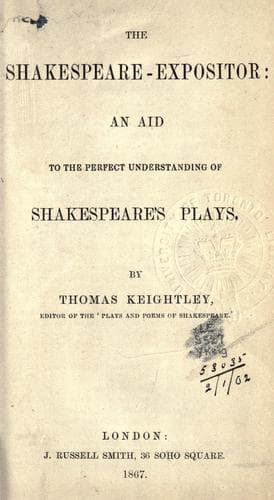
The Shakespeare-Expositor: An Aid to the Perfect Understanding of Shakespeare's Plays — John Shaqi
The Shakespeare-Expositor: An Aid to the Perfect Understanding of Shakespeare's PlaysKeightley, Thomas
General
The Shakespeare-Expositor: An Aid to the Perfect Understanding of Shakespeare's Plays
Keightley, Thomas
Drama -- Outlines, syllabi, etc.; Shakespeare, William, 1564-1616 -- Outlines, syllabi, etc.
There is certainly no inherent improbability in this narrative; and it
may have had its effect in determining Shakespeare to quit Stratford.
But that it should have been the sole cause of his doing so is what I
am disposed to question. We must recollect that Shakespeare was a man
endowed with genius of the very highest order, and that he must have
aspired to a wider field for its exercise than his native town could
afford, that he had a family, and that his circumstances were very
slender, while those of his father, as we have sufficient evidence,
had been greatly reduced. Nor does it appear that he--who, as has
been already observed, except in the case of his marriage, was always
prudent--set out for London without having a definite object in view.
Now various companies of players, as we learn, were in the habit of
visiting Stratford, like other country towns, and performing there
in the Guildhall. It can be hardly doubted that Shakespeare, in
whom dramatic genius was inborn, must have been excited by these
performances, however low the merit of the pieces--perhaps even have
felt that he was capable of producing something superior to them of the
same kind. He probably then made the acquaintance of the players, one
of whom, Burbage, was, it is supposed, a native of the town, and some
others, natives of the county, and proposed embracing their profession.
He was young, handsome, of animated and even brilliant conversation.
There can be little doubt, then, that he met with encouragement, and
was readily received among them. This was, it is most likely, in the
year 1586, when he was two-and-twenty. Rowe says "he was received into
the company at first in a very mean rank;" and in 1693 the parish-clerk
of Stratford, a man eighty years of age, told a person named Dowdall,
that he "was received into the playhouse as a serviture." Of course,
like almost every other actor, he began at the bottom, having as it
were to serve his apprenticeship. This, then, seems to be all true
enough; not so another tradition, related by Johnson as coming from
Pope and Rowe, namely, that his first occupation in London was holding
gentlemen's horses at the door of the playhouse, in which business he
succeeded so well that he hired boys to act under him. How little like
Shakespeare this is need hardly be said.
A question which cannot be answered very satisfactorily is, What did
Shakespeare at this time do with his wife and children? The probability
would seem to be, that he left them at Stratford, and, as is most
likely, at his father's, till he should see what success he was likely
to meet with in London.
Public-domain text, read in full here on John Shaqi.
Reviews
Reviews
No reviews yet
Be the first to share your thoughts on this work.
Join the Discussion
Join the discussion
Sign in to leave a comment or review.
Sign InorCreate an account