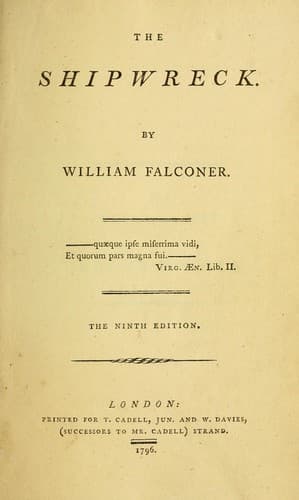
Falconer originally designed the Poem, (as appears from an advertisement
prefixed to the second edition, published in 1764,) for the entertainment
of “the gentlemen of the sea;” but he complains that they had not formed
one tenth of the purchasers. He printed that edition in a cheaper form,
expressly with a view to render it more acceptable to the inferior
officers. Falconer was thoroughly the seaman; he was warmly attached to
the profession, and prided himself more on his nautical science than on
his literary talents. The author of the SHIPWRECK compiled a “Universal
Dictionary of the Marine,” a work which cost him years of extraordinary
application. The SHIPWRECK is said to comprise within itself the
rudiments of navigation, so as even to claim to be considered as a
grammar of the nautical science. The correctness of the rules and maxims
laid down in the Poem, for the conduct of a ship under circumstances of
perilous emergency, render it extremely valuable to the seaman. The notes
originally affixed to the Poem, in explanation of the technical terms,
the frequent introduction and euphonous arrangement of which, form so
striking a peculiarity of the composition, were thought necessary by the
Author, on account of there being, at that time, no modern dictionaries
to which he could refer the reader, without forfeiting, by his implied
commendation of them, his claim to the professional character he had
assumed,—a claim of which he professes himself to be much more tenacious,
than of his reputation as a poet.
Fresh-water critics venture out of their element in entering upon a
minute examination of such a poem as this. The care with which it
appears to have been elaborated, has, however, left little for the
invidious notice of criticism. In a few instances, the hand of correction
has been injudiciously applied in the editions of the Poem subsequent to
its first appearance; it is conjectured, that some of the alterations
in the third edition, which are of this nature, are to be attributed to
his having left the final revision to his friend Mallet, who, although
a poet, was not a seaman. If the style of the Poem is faulty in any
respect, it is in that of the too ambitious phraseology, by which it
seems to have been Falconer’s effort to sustain the epic dignity of the
narrative. Into this fault the models of the day were adapted to seduce
any young writer, and the versification he adopted, presents a constant
temptation to artificial and inverted forms of expression. Thus, for
instance, to weigh anchor, is paraphrased in the following line:—
“Or win the anchor from its dark abode.”
Public-domain text, read in full here on John Shaqi.
Reviews
Reviews
No reviews yet
Be the first to share your thoughts on this work.
Join the Discussion
Join the discussion
Sign in to leave a comment or review.
Sign InorCreate an account