The frequency of the classical allusions, by which also the Poet probably
intended to render his work more _secundum artem_ poetical, is justified
by their local propriety. As suggested by the surrounding scenery,
they seem perfectly natural, and they are introduced, generally, with
considerable skill and effect. The most pleasing parts of the Poem,
however, are those in which the narration is characterized by all
the simplicity of the seaman, rather than by the embellishments of a
half-learned taste.
Short and simple are the annals of poor ARION’S history. He was born at
Edinburgh, about the year 1730. His father was a poor but industrious
barber, who had to maintain a large family, under the distressing
circumstance of all his children, with the single exception of William,
being either deaf or dumb. Reading English, writing, and a little
arithmetic, comprised the whole of Falconer’s education, although he
afterwards acquired some knowledge of the French, Spanish, and Italian
languages, and, it is added, even of the German. When very young, he
entered on board a merchant vessel at Leith, in which he served an
apprenticeship. He was afterwards servant to Campbell, the author
of Lexiphanes, when purser of a ship, who is stated to have taken
considerable pains in improving the mind of the young seaman, and to
have subsequently felt a pride in boasting of his scholar. At what
time the calamitous event occurred, which furnished the subject of the
SHIPWRECK, has not been ascertained: he was then, it appears, employed
in the Levant trade. He continued in the merchant service till 1762. In
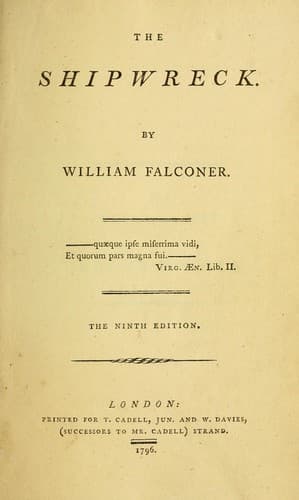
that year, the SHIPWRECK made its first appearance, in quarto, dedicated
to his Royal Highness Edward, Duke of York, who had hoisted his flag as
rear-admiral of the blue, on board the Princess Amelia, of eighty guns,
attached to the fleet under Sir Edward Hawke. The Poem immediately took
with the public, and Falconer, having, as it is said, at the Duke’s
recommendation, quitted the merchant service for the royal navy, was
soon after rated a midshipman on board the Royal George.
At the peace of 1763, the Royal George was paid off, and Falconer, in the
course of the same year, was appointed purser of the Glory frigate. Soon
after this, he married a young lady of the name of Hicks, who survived
him. From the Glory, he was, in 1767, appointed to the Swiftsure.
Public-domain text, read in full here on John Shaqi.
Reviews
Reviews
No reviews yet
Be the first to share your thoughts on this work.
Join the Discussion
Join the discussion
Sign in to leave a comment or review.
Sign InorCreate an account