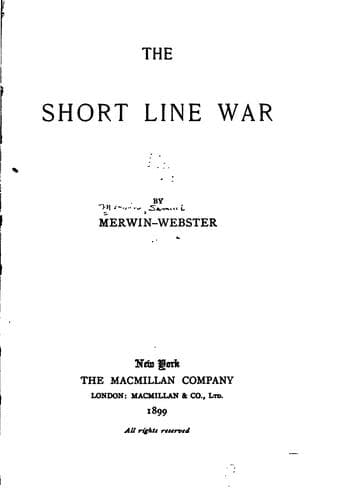
Historical fiction; Railroads -- History -- Fiction
He put the paper in his pocket, then locked his desk, and with a word
to Pease he left the office. Jim dined down town, and not until after
dinner did he think of Harvey and his leave of absence. He would need
his secretary to-morrow, and it would not do to have him out of reach.
But the moments of reminiscence that afternoon came to Harvey's rescue,
and Jim in the most unbusinesslike way decided to get on without his
secretary. “He can't go through that but once,” thought Jim.
He left the restaurant and walked rapidly to the Northern Station,
and for the second time that week the Northern Limited took Jim to
Manchester.
Jim was going to see Judge Grey. He had already decided what he wanted
the Judge to do; whether he could get him to do it was another question,
which Jim was going to put to the test as soon as possible.
The trains on the Northern in coming into Manchester run down the middle
of one of the main business streets, and engineers are compelled by city
statutes to run slowly. As the Limited slowed down, Jim walked out on
the rear platform and stood gazing at the brightly lighted shop windows.
At an intersecting street he saw a trolley car waiting for the train to
pass; the blue light it showed told Jim it was the car he wanted, so
he swung quickly off the train and stepped aboard the car as it came
bumping over the crossing. It was evidently behind its schedule, for
once on clear track again it sped along rapidly. A man was running to
catch the car, and Jim watched him with amused interest. At first he
gained, but as the speed of the car increased he gave up the race; but
he had come near enough for Jim to recognize him as the man who had
dined only a few tables from him that evening in Chicago and who had
sat a few seats behind him on the Limited. Jim smiled. “They're mighty
anxious to know what I'm doing,” he thought.
Judge Grey did not go away on vacations. He was a homely man, with a
large family, and he took serious views of life. He was country bred,
and he had never outgrown a certain rusticity of appearance. It was said
that his wife always cut his hair, and the concentric circles made by
the neatly trimmed ends lent verisimilitude to the tale that she began
at the crown with a butter dish to guide her scissors, then extended the
diameter of her circle by using next a saucer, and last a soup bowl.
Public-domain text, read in full here on John Shaqi.
Reviews
Reviews
No reviews yet
Be the first to share your thoughts on this work.
Join the Discussion
Join the discussion
Sign in to leave a comment or review.
Sign InorCreate an account