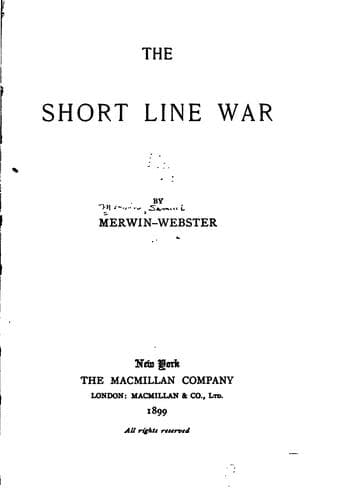
Historical fiction; Railroads -- History -- Fiction
The Judge greeted Jim warmly, invited him into the library, and sat down
to hear what he had to say. Jim told him almost without reservation the
story of the fight for the possession of M. & T., beginning with his
large investment in the road and his election to the presidency of it.
He did not try to make a good story; he told what had happened as simply
and briefly as possible, and he interested Judge Grey. Part of it was
already known to him, and part filled in gaps in his knowledge. To him
it was the story of an honest struggle for something worth struggling
for. When it came to the latest move, and Jim without comment handed him
Black's injunction, the Judge's wrath flamed out.
“That's an outrage!” he exclaimed. “It's just a legal hold-up.”
“Possibly,” said Jim. “It was the best move they could make, though.
But,” he went on after a short pause, “I've got the right in this
business, and I want you to help me.”
“You want me to dissolve the injunction, I suppose,” said the Judge,
cautiously.
“No,” said Jim. “I don't. Just the other way. I'd like you to issue an
injunction that will go a little farther.”
There was another short pause, and then Jim began explaining his
plan. As he explained and argued, the fire, which had been crackling
cheerfully when he came in, flickered more and more faintly, and it was
but a fading glow when that most informal session of the Circuit Court
in chancery sitting came to its conclusion.
“That's all right, then,” said Jim at length, rising as he spoke.
“Yes,” said the other. “We'll do it that way. Are you going right back
to Chicago, Mr. Weeks?”
“No,” said Jim. “I shall be here for some time. From now on this fight
will be along the line of the road.”
Mr. Wing was oppressed by a sense of his office boy's superiority. He
read disapprobation in the round-eyed stare, and even the cut-steel
buttons, though of Wing's own purveying, seemed arguslike in their
critical surveillance. He would have abolished them had he not felt that
the boy would understand the change. If the boy had only forgotten to
copy letters or had manifested an unruly desire to attend his relatives'
funerals, his employer would have been a happier man. As it was, he felt
apologetic every time he came in late or went out early.
The directors' meeting which Porter and Thompson had decided upon
on Friday was to take place the next afternoon in Wing's office; so,
contrary to the little man's custom on Saturday afternoons, he returned
thither after lunch.
Public-domain text, read in full here on John Shaqi.
Reviews
Reviews
No reviews yet
Be the first to share your thoughts on this work.
Join the Discussion
Join the discussion
Sign in to leave a comment or review.
Sign InorCreate an account