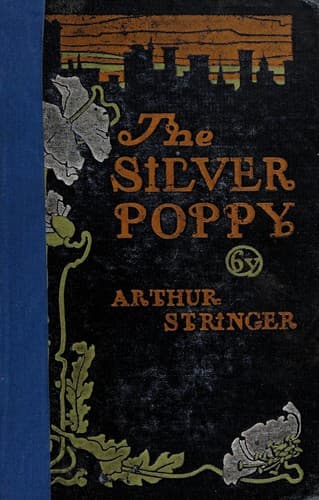
Authors -- Fiction; Canadian fiction; Impostors and imposture -- Fiction; New York (N.Y.) -- Social life and customs -- Fiction
The door opened slowly, timorously, and Cordelia stood before him, with
her hand on the knob.
She looked at him in silence, studying his impassive face with pleading,
unwavering eyes, seeming to drink in every detail of feature and
expression, searching for something she had, perhaps, half-hoped to find
there, startled, too, at the change in him.
"John," she said, in a whisper, taking a step toward him. He looked at
her, unrelaxed, without moving.
"John," she whispered once more, pitifully, creeping a step or two
closer to him, and stopping again.
She was dressed all in black, and wore a heavy black-plumed hat that
framed the white oval of her face; it was a face that looked tired and
wan and touched with the twilight of lost happiness. In her hand she
carried a great cluster of lilies of the valley. Their sickly, heavy,
penetrating fragrance surrounded her and floated in with her, until
Hartley himself could smell it. For all the rest of her days the odor
of lilies of the valley was hateful to her.
She stood there for a moment, still hesitating, and then turned and
closed the door, which had remained open behind her.
"You--you are not going away?" she gasped.
He was glad, inwardly, that it was all definitely settled, that no
mischance could now turn him back, that even his own hand could no
longer bar his outward way.
"I'm going to England to-morrow," he said, impassively. He stooped and
turned the key in his steamer-trunk with a movement of determined
conclusiveness that did not escape her.
"You are going," she echoed, "forever?"
She crept toward him, meekly, wistfully; she touched him with her hand.
He was sallow and shrunken, with new, hard lines about the once boyish
mouth; but to the woman who clutched at his arm, he was a lover clothed
in beauty and a liberating angel of redemption in one.
"John," she said, in a low half-sob, "you won't--you can't leave me,
without a word?"
He drew back from her; he, too, was humbled and broken, but the pride of
his youth and the pride of his race still clung to him.
"There is nothing for me to say," he answered, coldly. He asked himself
fiercely why he had half-heartedly wished, so many times, to see her but
once, before going.
With a sudden impetuous movement she ran to him and flung her arms about
him, clinging to him, panting and shaken.
"I love you; oh, I love you!" she cried out, passionately, locking each
thin arm about his resisting body. He no longer tried to force her away,
and she clung to him and cried out again and again: "I love you, my own,
I love you!"
Yet he stood unmoved, feeling as though she had long since drained to
the bottom his deepest springs of emotion; now he could neither care nor
resist.
Public-domain text, read in full here on John Shaqi.
Reviews
Reviews
No reviews yet
Be the first to share your thoughts on this work.
Elsewhere in the archive
Join the Discussion
Join the discussion
Sign in to leave a comment or review.
Sign InorCreate an account