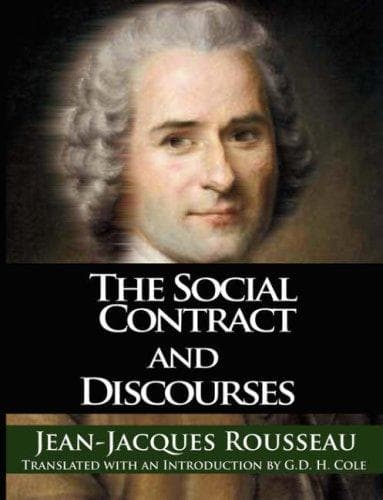
The social contract & discoursesRousseau, Jean-Jacques
Philosophy
The social contract & discourses
Rousseau, Jean-Jacques
Economics; Political science -- Early works to 1800; Social contract
means by "nature" in this period not the original state of a thing,
nor even its reduction to the simplest terms: he is passing over to
the conception of "nature" as identical with the full development of
capacity, with the higher! idea of human freedom. This view may be seen
in germ even in the _Discourse on Inequality_, where, distinguishing
self-respect (_amour de soi_) from egoism (_amour-propre_), Rousseau
makes the former, the property of the "natural" man, consist not in
the desire for self-aggrandisement, but in the seeking of satisfaction
for reasonable desire accompanied by benevolence; whereas egoism is
the preference of our own interests to those of others, self-respect
merely puts us on an equal footing with our fellows. It is true that
in the Discourse Rousseau is pleading against the development of many
human faculties; but he is equally advocating the fullest development
of those he regards as "natural," by which he means merely "good."
The "state of society," as envisaged in the _Social Contract_, is no
longer in contradiction to the "state of nature" upheld in the _Emile_,
where indeed the social environment is of the greatest importance, and,
though the pupil is screened from it, he is none the less being trained
for it. Indeed the views given in the _Social Contract_ are summarised
in the fifth book of the _Emile_, and by this summary the essential
unity of Rousseau's system is emphasised.
Rousseau's object, then, in the first words of the _Social Contract_,
"is to inquire if, in the civil order, there can be any sure and
certain, rule of administration, taking men as they are and laws as
they might be." Montesquieu took laws as they were, and saw what sort
of men they made: Rousseau, founding his whole system on human freedom,
takes man as the basis, and regards him as giving himself what laws he
pleases. He takes his stand on the nature of human freedom: on this he
bases his whole system, making the will of the members the sole basis
of every society.
In working out his theory, Rousseau makes use throughout of three
general and, to some extent, alternative conceptions. These are the
Social Contract, Sovereignty and the General Will. We shall now have to
examine each of these in turn.
Public-domain text, read in full here on John Shaqi.
Reviews
Reviews
No reviews yet
Be the first to share your thoughts on this work.
Join the Discussion
Join the discussion
Sign in to leave a comment or review.
Sign InorCreate an account