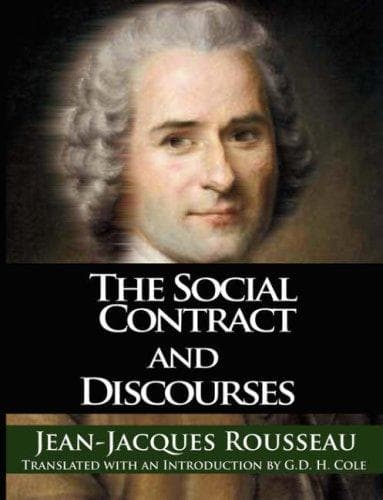
The social contract & discoursesRousseau, Jean-Jacques
Philosophy
The social contract & discourses
Rousseau, Jean-Jacques
Economics; Political science -- Early works to 1800; Social contract
The Social Contract theory is as old as the sophists of Greece (see
Plato, _Republic_, Book II and the _Gorgias_), and as I elusive.
It has been adapted to the most opposite points of view, and used,
in different forms, on both sides of every question to which it
could conceivably be applied. It is frequent in mediæval writers,
a commonplace with the theorists of the Renaissance, and in the
eighteenth century already nearing its fall before a wider conception.
It would be a long, as well as a thankless, task to trace its history
over again: it may be followed best in D. G. Ritchie's admirable essay
on it in _Darwin and Hegel and Other Studies_. For us, it is important
only to regard it in its most general aspect, before studying the
special use made of it by Rousseau. Obviously, in one form or another,
it is a theory very easily arrived at. Wherever any form of government
apart from the merest tyranny exists, reflection on the basis of the
State cannot but lead to the notion that, in one sense or another,
it is based on the consent, tacit or expressed, past or present, of
its members. In this alone, the greater part of the Social Contract
theory is already latent. Add the desire to find actual justification
for a theory in facts, and, especially in an age possessed only of the
haziest historical sense, this doctrine of consent will inevitably
be given a historical setting. If in addition there is a tendency
to regard society as something unnatural to humanity, the tendency
will become irresistible. By writers of almost all schools, the
State will be represented as having arisen, in some remote age, out
of a compact or, in more legal phrase, contract between two or more
parties. The only class that will be able to resist the doctrine is
that which maintains the divine right of kings, and holds that all
existing governments were were imposed on the people by the direct
interposition of God. All who are not prepared to maintain that will be
partisans of some form or other of the Social Contract theory.
It is, therefore, not surprising that we find among its advocates
writers of the most opposite points of view. Barely stated, it is a
mere formula, which may be filled in with any content from absolutism
to pure republicanism. And, in the hands of some at least of its
supporters, it turns out to be a weapon that cuts both ways. We shall
be in a better position to judge of its usefulness when we have seen
its chief varieties at work.
All Social Contract theories that are at all definite fall under one
or other of two heads. They represent society as based on an original
contract either between the people and the government, or between all
the individuals composing the State. Historically, modern theory passes
from the first to the second of these forms.
Public-domain text, read in full here on John Shaqi.
Reviews
Reviews
No reviews yet
Be the first to share your thoughts on this work.
Join the Discussion
Join the discussion
Sign in to leave a comment or review.
Sign InorCreate an account