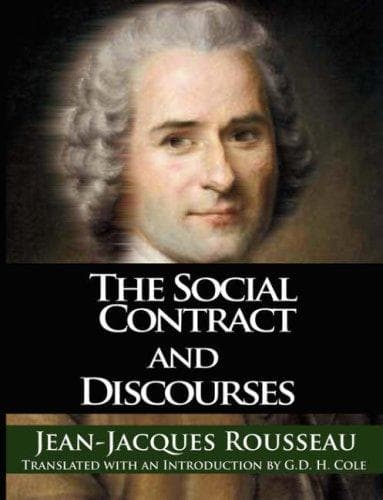
The social contract & discoursesRousseau, Jean-Jacques
Philosophy
The social contract & discourses
Rousseau, Jean-Jacques
Economics; Political science -- Early works to 1800; Social contract
[4] See, for instance, in a letter from Grotius to his brother (April
11, 1643), what that learned man found to praise and to blame in the
_De Cive._ It is true that, with a bent for indulgence, he seems to
pardon the writer the good for the sake of the bad; but all men are not
so forgiving.
[5] "In the republic," says the Marquis d'Argenson, "each man is
perfectly free in what does not harm others." This is the invariable
limitation, which it is impossible to define more exactly. I have not
been able to deny myself the pleasure of occasionally quoting from this
manuscript, though it is unknown to the public, in order to do honour
to the memory of a good and illustrious man, who had kept even in the
Ministry the heart of a good citizen, and views on the government of
his country that were sane and right.
[6] Cæsar, pleading for Catiline, tried to establish the dogma that the
soul is mortal: Cato and Cicero, in refutation, did not waste time in
philosophising. They were content to show that Cæsar spoke like a bad
citizen, and brought forward a doctrine that would have a bad effect on
the State. This, in fact, and not a problem of theology, was what the
Roman senate had to judge.
[7] Marriage, for instance, being a civil contract, has civil effects
without which society cannot even subsist. Suppose a body of clergy
should claim the sole right of permitting this act, a right which every
intolerant religion must of necessity claim, is it not clear that in
establishing the authority of the Church in this respect, it will be
destroying that of the prince, who will have thenceforth only as many
subjects as the clergy choose to allow him? Being in a position to
marry or not to marry people, according to their acceptance of such
and such a doctrine, their admission or rejection of such and such a
formula, their greater or less piety, the Church alone, by the exercise
of prudence and firmness, will dispose of all inheritances, offices
and citizens, and even of the State itself, which could not subsist
if it were composed entirely of bastards? But, I shall be told, there
will be appeals on the ground of abuse, summonses and decrees; the
temporalities will be seized. How sad! The clergy, however little, I
will not say courage, but sense it has, will take no notice and go its
way: it will quietly allow appeals, summonses, decrees and seizures,
and, in the end, will remain the master. It is not, I think, a great
sacrifice to give up a part, when one is sure of securing all.
CHAPTER IX
CONCLUSION
Now that I have laid down the true principles of political right, and
tried to give the State a basis of its own to rest on, I ought next
to strengthen it by its external relations, which would include the
law of nations, commerce, the right of war and conquest, public right,
leagues, negotiations, treaties, etc. But all this forms a new subject
that is far too vast for my narrow scope. I ought throughout to have
kept to a more limited sphere.
Public-domain text, read in full here on John Shaqi.
Reviews
Reviews
No reviews yet
Be the first to share your thoughts on this work.
Elsewhere in the archive
Join the Discussion
Join the discussion
Sign in to leave a comment or review.
Sign InorCreate an account