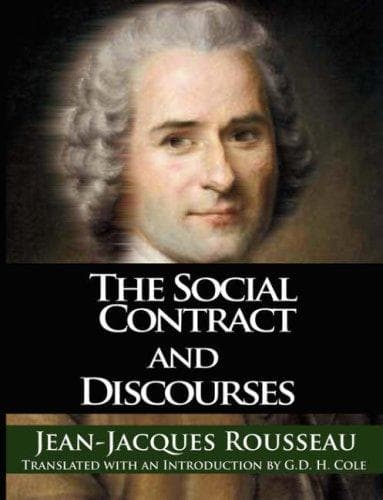
The social contract & discoursesRousseau, Jean-Jacques
Philosophy
The social contract & discourses
Rousseau, Jean-Jacques
Economics; Political science -- Early works to 1800; Social contract
A DISCOURSE
WHICH WON THE PRIZE AT THE ACADEMY OF DIJON IN 1750, ON THIS QUESTION
PROPOSED BY THE ACADEMY:
HAS THE RESTORATION OF THE ARTS AND SCIENCES HAD A PURIFYING EFFECT
UPON MORALS?
Barbaras his ego sum, qui non intelligor illis.--OVID.[1]
[1] Here I am, a barbarian, because men understand me not.
PREFACE
The following pages contain a discussion of one of the most sublime
and interesting of all moral questions. It is not concerned, however,
with those metaphysical subtleties, which of late have found their way
into every department of literature, and from which even our academic
curricula are not always free. We have now to do with one of those
truths on which the happiness of mankind depends.
I foresee that I shall not readily be forgiven for having taken up the
position I have adopted. Setting myself up against all that is nowadays
most admired, I can expect no less than a universal outcry against me:
nor is the approbation of a few sensible men enough to make me count
on that of the public. But I have taken my stand, and I shall be at no
pains to please either intellectuals or men of the world. There are in
all ages men born to be in bondage to the opinions of the society in
which they live. There are not a few, who to-day play the free-thinker
and the philosopher, who would, if they had lived in the time of the
League, have been no more than fanatics. No author, who has a mind to
outlive his own age, should write for such readers.
A word more and I have done. As I did not expect the honour conferred
on me, I had, since sending in my Discourse, so altered and enlarged
it as almost to make it a new work; but in the circumstances I have
felt bound to publish it just as it was when it received the prize. I
have only added a few notes, and left two alterations which are easily
recognisable, of which the Academy possibly might not have approved.
The respect, gratitude and even justice I owe to that body seemed to me
to demand this acknowledgment.
MORAL EFFECTS
OF THE ARTS AND SCIENCES
_Decipimur specie recti_.--HORACE.
The question before me is, "Whether the Restoration of the arts and
sciences has had the effect of purifying or corrupting morals." Which
side am I to take? That, gentlemen, which becomes an honest man, who is
sensible of his own ignorance, and thinks himself none the worse for it.
I feel the difficulty of treating this subject fittingly, before the
tribunal which is to judge of what I advance. How can I presume to
belittle the sciences before one of the most learned assemblies in
Europe, to commend ignorance in a famous Academy, and reconcile my
contempt for study with the respect due to the truly learned?
I was aware of these inconsistencies, but not discouraged by them. It
is not science, I said to myself, that I am attacking; it is virtue
that I am defending, and that before virtuous men--and goodness is even
dearer to the good than learning to the learned.
Public-domain text, read in full here on John Shaqi.
Reviews
Reviews
No reviews yet
Be the first to share your thoughts on this work.
Elsewhere in the archive
Join the Discussion
Join the discussion
Sign in to leave a comment or review.
Sign InorCreate an account