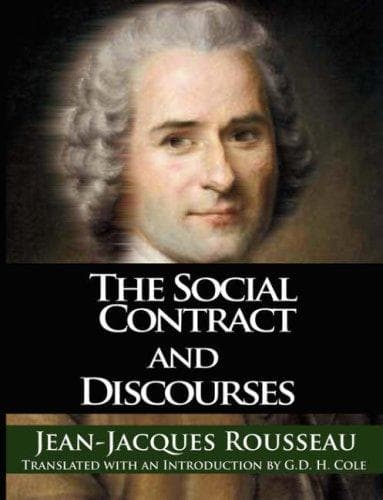
The social contract & discoursesRousseau, Jean-Jacques
Philosophy
The social contract & discourses
Rousseau, Jean-Jacques
Economics; Political science -- Early works to 1800; Social contract
Charles the Eighth found himself master of Tuscany and the kingdom of
Naples, almost without drawing sword; and all his court attributed
this unexpected success to the fact that the princes and nobles of
Italy applied themselves with greater earnestness to the cultivation
of their understandings than to active and martial pursuits. In fact,
says the sensible person who records these characteristics, experience
plainly tells us, that in military matters and all that resemble them
application to the sciences tends rather to make men effeminate and
cowardly than resolute and vigorous.
The Romans confessed that military virtue was extinguished among them,
in proportion as they became connoisseurs in the arts of the painter,
the engraver and the goldsmith, and began to cultivate the fine arts.
Indeed, as if this famous country was to be for ever an example to
other nations, the rise of the Medici and the revival of letters has
once more destroyed, this time perhaps for ever, the martial reputation
which Italy seemed a few centuries ago to have recovered.
The ancient republics of Greece, with that wisdom which was so
conspicuous in most of their institutions, forbade their citizens
to pursue all those inactive and sedentary occupations, which by
enervating and corrupting the body diminish also the vigour of the
mind. With what courage, in fact, can it be thought that hunger and
thirst, fatigues, dangers and death, can be faced by men whom the
smallest want overwhelms and the slightest difficulty repels? With what
resolution can soldiers support the excessive toils of war, when they
are entirely unaccustomed to them? With what spirits can they make
forced marches under officers who have not even the strength to travel
on horseback? It is no answer to cite the reputed valour of all the
modern warriors who are so scientifically trained. I hear much of their
bravery in a day's battle; but I am told nothing of how they support
excessive fatigue, how they stand the severity of the seasons and the
inclemency of the weather. A little sunshine or snow, or the want
of a few superfluities, is enough to cripple and destroy one of our
finest armies in a few days. Intrepid warriors I permit me for once to
tell you the truth, which you seldom hear. Of your bravery I am fully
satisfied. I have no doubt that you would have triumphed with Hannibal
at Cannæ, and at Trasimene: that you would have passed the Rubicon
with Cæsar, and enabled him to enslave his country; but you never would
have been able to cross the Alps with the former, or with the latter to
subdue your own ancestors, the Gauls.
Public-domain text, read in full here on John Shaqi.
Reviews
Reviews
No reviews yet
Be the first to share your thoughts on this work.
Elsewhere in the archive
Join the Discussion
Join the discussion
Sign in to leave a comment or review.
Sign InorCreate an account