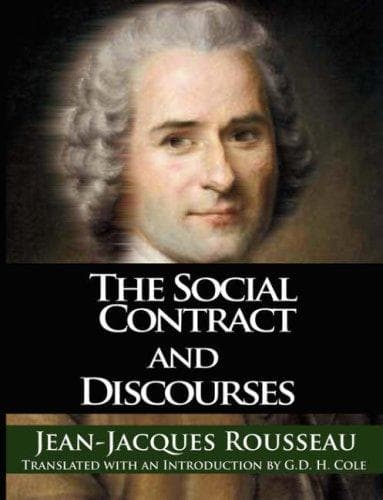
The social contract & discoursesRousseau, Jean-Jacques
Philosophy
The social contract & discourses
Rousseau, Jean-Jacques
Economics; Political science -- Early works to 1800; Social contract
It is, therefore, essential to distinguish between the legal Sovereign
of jurisprudence, and the political Sovereign of political science
and philosophy. Even so, it does not at once become clear what this
political Sovereign may be. Is it the body or bodies of persons in whom
political power in a State actually resides? Is it merely the complex
of actual institutions regarded as embodying the will of the society?
This would leave us still in the realm of mere fact, outside both right
and philosophy. The Sovereign, in the philosophical sense, is neither
the nominal Sovereign, nor the legal Sovereign, nor the political
Sovereign of fact and common sense: it is the consequence of the
fundamental bond of union, the restatement of the doctrine of Social
Contract, the foreshadowing of that of General Will. The Sovereign
is that body in the State in which political _power ought_ always to
reside, and in which the _right_ to such power _does_ always reside.
The idea at the back of the philosophical conception of Sovereignty
is, therefore, essentially the same as that we found to underlie the
Social Contract theory. It is the view that the people, whether it
can alienate its right or not, is the ultimate director of its own
destinies, the final power from which there is no appeal. In a sense,
this is recognised even by Hobbes, who makes the power of his absolute
Sovereign, the predecessor of Austin's "determinate human superior,"
issue first of all from the Social Contract, which is essentially a
popular act. The difference between Hobbes and Rousseau on this point
is solely that Rousseau regards as inalienable a supreme power which
Hobbes makes the people alienate in its first corporate action. That
is to say, Hobbes in fact accepts the theory of popular supremacy in
name only to destroy it in fact; Rousseau asserts the theory in its
only logical form, and is under no temptation to evade it by means of
false historical assumptions. In Locke, a distinction is already drawn
between the legal and the actual Sovereign, which Locke calls "supreme
power"; Rousseau unites the absolute Sovereignty of Hobbes and the
"popular consent" of Locke into the philosophic doctrine of popular
Sovereignty, which has since been the established form of the theory.
His final view represents a return from the perversions of Hobbes to
a doctrine already familiar to mediæval and Renaissance writers; but
it is not merely a return. In its passage the view has fallen into its
place in a complete system of political philosophy.
Public-domain text, read in full here on John Shaqi.
Reviews
Reviews
No reviews yet
Be the first to share your thoughts on this work.
Join the Discussion
Join the discussion
Sign in to leave a comment or review.
Sign InorCreate an account