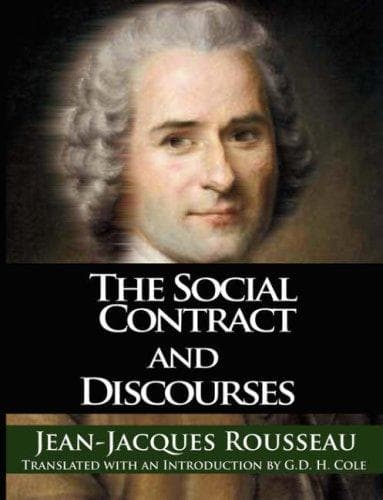
The social contract & discoursesRousseau, Jean-Jacques
Philosophy
The social contract & discourses
Rousseau, Jean-Jacques
Economics; Political science -- Early works to 1800; Social contract
In a second important respect Rousseau differentiates himself from
Hobbes. For Hobbes, the Sovereign is identical with the government.
He is so hot for absolutism largely because he regards revolution,
the overthrow of the existing government, as at the same time the
dissolution of the body politic, and a return to complete anarchy or to
the "state of nature." Rousseau and, to some extent, Locke meet this
view by sharp division between the supreme power and the government.
For Rousseau, they are so clearly distinct that even a completely
democratic government is not at the same time the Sovereign; its
members are sovereign only in a different capacity and as a different
corporate body, just as two different societies may exist for different
purposes with exactly the same members. Pure democracy, however, the
government of the State by all the people in every detail, is not,
as Rousseau says, a possible human institution. All governments are
really _mixed_ in character; and what we call a democracy is only a
more or less democratic government. Government, therefore, will always
be to some extent in the hands of selected persons. Sovereignty, on
the other hand, is in his view absolute, inalienable, indivisible, and
indestructible. It cannot be limited, abandoned, shared or destroyed.
It is an essential part of all social life that the right to control
the destinies of the State belongs in the last resort to the whole
people. There clearly must in the end be somewhere in the society an
ultimate court of appeal, whether determinate or not; but, unless
Sovereignty is distinguished from government, the government, passing
under the name of Sovereign, will inevitably be regarded as absolute.
The only way to avoid the conclusions of Hobbes is, therefore, to
establish a clear separation between them.
Rousseau tries to do this by an adaptation of the doctrine of the
"three powers." But instead of three independent powers sharing the
supreme authority, he gives only two, and makes one of these wholly
dependent on the other. He substitutes for the co-ordination of the
legislative, the executive, and the judicial authorities, a system
in which the legislative power, or Sovereign, is always supreme, the
executive, or government, always secondary and derivative, and the
judicial power merely a function of government. This division he makes,
naturally, one of _will_ and _power_. The government is merely to carry
out the decrees, or acts of will, of the Sovereign people. Just as
the human will transfers a command to its members for execution, so
the body politic may give its decisions force by setting up authority
which, like the brain, may command its members. In delegating the power
necessary for the execution of its will, it is abandoning none of its
supreme authority. It remains Sovereign, and can at any moment recall
the grants it has made. Government, therefore, exists only at the
Sovereign's pleasure, and is always revocable by the sovereign will.
Public-domain text, read in full here on John Shaqi.
Reviews
Reviews
No reviews yet
Be the first to share your thoughts on this work.
Join the Discussion
Join the discussion
Sign in to leave a comment or review.
Sign InorCreate an account