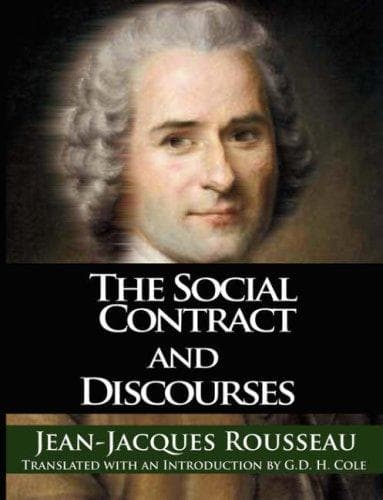
The social contract & discoursesRousseau, Jean-Jacques
Philosophy
The social contract & discourses
Rousseau, Jean-Jacques
Economics; Political science -- Early works to 1800; Social contract
Thus, as the most powerful or the most miserable considered their might
or misery as a kind of right to the possessions of others, equivalent,
in their opinion, to that of property, the destruction of equality
was attended by the most terrible disorders. Usurpations by the rich,
robbery by the poor, and the unbridled passions of both, suppressed
the cries of natural compassion and the still feeble voice of justice,
and filled men with avarice, ambition and vice. Between the title of
the strongest and that of the first occupier, there arose perpetual
conflicts, which never ended but in battles and bloodshed. The new-born
state of society thus gave rise to a horrible state of war; men thus
harassed and depraved were no longer capable of retracing their steps
or renouncing the fatal acquisitions they had made, but, labouring by
the abuse of the faculties which do them honour, merely to their own
confusion, brought themselves to the brink of ruin.
_Attonitus novitate mali, divesque miserque,_
_Effugere optat opes; et quæ modô voverat odit._[5]
It is impossible that men should not at length have reflected on so
wretched a situation, and on the calamities that overwhelmed them.
The rich, in particular, must have felt how much they suffered by a
constant state of war, of which they bore all the expense; and in
which, though all risked their lives, they alone risked their property.
Besides, however speciously they might disguise their usurpations,
they knew that they were founded on precarious and false titles; so
that, if others took from them by force what they themselves had
gained by force, they would have no reason to complain. Even those
who had been enriched by their own industry, could hardly base their
proprietorship on better claims. It was in vain to repeat, "I built
this well; I gained this spot by my industry." Who gave you your
standing, it might be answered, and what right have you to demand
payment of us for doing what we never asked you to do? Do you not
know that numbers of your fellow-creatures are starving, for want
of what you have too much of? You ought to have had the express and
universal consent of mankind, before appropriating more of the common
subsistence than you needed for your own maintenance. Destitute of
valid reasons to justify and sufficient strength to defend himself,
able to crush individuals with ease, but easily crushed himself by a
troop of bandits, one against all, and incapable, on account of mutual
jealousy, of joining with his equals against numerous enemies united
by the common hope of plunder, the rich man, thus urged by necessity,
conceived at length the profoundest plan that ever entered the mind of
man: this was to employ in his favour the forces of those who attacked
him, to make allies of his adversaries, to inspire them with different
maxims, and to give them other institutions as favourable to himself as
the law of nature was unfavourable.
Public-domain text, read in full here on John Shaqi.
Reviews
Reviews
No reviews yet
Be the first to share your thoughts on this work.
Elsewhere in the archive
Join the Discussion
Join the discussion
Sign in to leave a comment or review.
Sign InorCreate an account