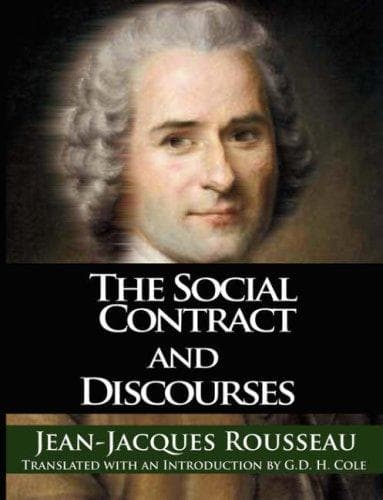
The social contract & discoursesRousseau, Jean-Jacques
Philosophy
The social contract & discourses
Rousseau, Jean-Jacques
Economics; Political science -- Early works to 1800; Social contract
It will be seen, when we come to discuss the nature of the General
Will, that this doctrine really contains the most valuable part of
Rousseau's theory. Here, we are concerned rather with its limitations.
The distinction between legislative and executive functions is
in practice very hard to draw. In Rousseau's case, it is further
complicated by the presence of a second distinction. The legislative
power, the Sovereign, is concerned only with what is general, the
executive only with what is particular. This distinction, the full
force of which can only be seen in connection with the General Will,
means roughly that a matter is general when it concerns the whole
community equally, and makes no mention of any particular class; as
soon as it refers to any class or person, it becomes particular, and
can no longer form the subject matter of an act of Sovereignty. However
just this distinction may seem in the abstract, it is clear that its
effect is to place all the power in the hands of the executive: modern
legislation is almost always concerned with particular classes and
interests. It is not, therefore, a long step from the view of Rousseau
to the modern theory of democratic government, in which the people has
little power beyond that of removing its rulers if they displease it.
As long, however, as we confine our view to the city-state of which
Rousseau is thinking, his distinction is capable of preserving for the
people a greater actual exercise of will. A city can often generalise
where a nation must particularise.
Public-domain text, read in full here on John Shaqi.
Reviews
Reviews
No reviews yet
Be the first to share your thoughts on this work.
Join the Discussion
Join the discussion
Sign in to leave a comment or review.
Sign InorCreate an account