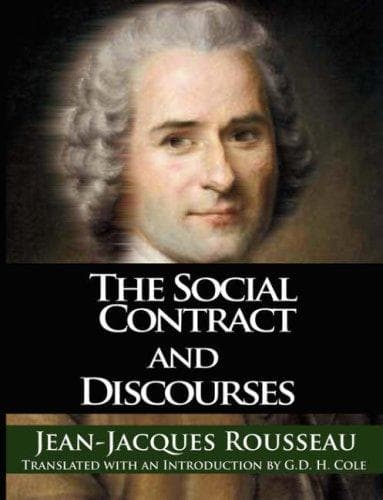
The social contract & discoursesRousseau, Jean-Jacques
Philosophy
The social contract & discourses
Rousseau, Jean-Jacques
Economics; Political science -- Early works to 1800; Social contract
In these different governments, all the offices were at first elective;
and when the influence of wealth was out of the question, the
preference was given to merit, which gives a natural ascendancy, and
to age, which is experienced in business and deliberate in council.
The Elders of the Hebrews, the Gerontes at Sparta, the Senate at Rome,
and the very etymology of our word Seigneur, show how old age was once
held in veneration. But the more often the choice fell upon old men,
the more often elections had to be repeated, and the more they became
a nuisance; intrigues set in, factions were formed, party feeling
grew--bitter, civil wars broke out; the lives of individuals were
sacrificed to the pretended happiness of the State; and at length men
were on the point of relapsing into their primitive anarchy. Ambitious
chiefs profited by these circumstances to perpetuate their offices
in their own families: at the same time the people, already used to
dependence, ease, and the conveniences of life, and already incapable
of breaking its fetters, agreed to an increase of its slavery, in order
to secure its tranquillity. Thus magistrates, having become hereditary,
contracted the habit of considering their offices as a family estate,
and themselves as proprietors of the communities of which they were at
first only the officers, of regarding their fellow-citizens as their
slaves, and numbering them, like cattle, among their belongings, and of
calling themselves the equals of the gods and longs of kings.
If we follow the progress of inequality in these various revolutions,
we shall find that the establishment of laws and of the right of
property was its first term, the institution of magistracy the second,
and the conversion of legitimate into arbitrary power the third and
last; so that the condition of rich and poor was authorised by the
first period; that of powerful and weak by the second; and only by the
third that of master and slave, which is the last degree of inequality,
and the term at which all the rest remain, when they have got so far,
till the government is either entirely dissolved by new revolutions, or
brought back again to legitimacy.
Public-domain text, read in full here on John Shaqi.
Reviews
Reviews
No reviews yet
Be the first to share your thoughts on this work.
Elsewhere in the archive
Join the Discussion
Join the discussion
Sign in to leave a comment or review.
Sign InorCreate an account