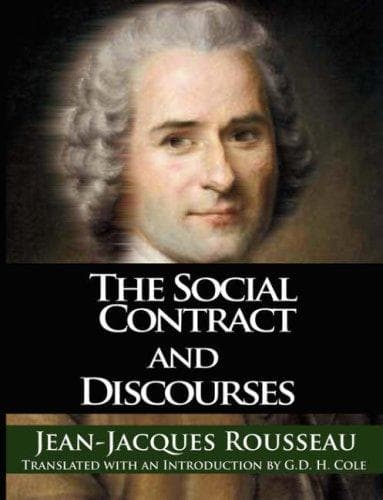
The social contract & discoursesRousseau, Jean-Jacques
Philosophy
The social contract & discourses
Rousseau, Jean-Jacques
Economics; Political science -- Early works to 1800; Social contract
When public funds are once established, the rulers of the State
become of right the administrators of them: for this administration
constitutes a part of government which is always essential, though
not always equally so. Its influence increases in proportion as that
of other resources is diminished; and it may justly be said that a
government has reached the last stage of corruption, when it has ceased
to have sinews other than money. Now as every government constantly
tends to become lax, this is enough to show why no State can subsist
unless its revenues constantly increase.
The first sense of the necessity of this increase is also the
first sign of the internal disorder of the State; and the prudent
administrator, in his endeavours to find means to provide for the
present necessity, will neglect nothing to find out the distant cause
of the new need; just as a mariner when he finds the water gaining
on his vessel, does not neglect, while he is working the pumps, to
discover and stop the leak.
From this rule is deduced the most important rule in the administration
of finance, which is, to take more pains to guard against needs than
to increase revenues. For, whatever diligence be employed, the relief
which only comes after, and more slowly than, the evil, always leaves
some injury behind. While a remedy is being found for one evil, another
is beginning to make itself felt, and even the remedies themselves
produce new difficulties: so that at length the nation is involved in
debt and the people oppressed, while the government loses its influence
and can do very little with a great deal of money. I imagine it was
owing to the recognition of this rule that such wonders were done by
ancient governments, which did more with their parsimony than ours do
with all their treasures; and perhaps from this comes the common use of
the word _economy_, which means rather the prudent management of what
one has than ways of getting what one has not.
Public-domain text, read in full here on John Shaqi.
Reviews
Reviews
No reviews yet
Be the first to share your thoughts on this work.
Elsewhere in the archive
Join the Discussion
Join the discussion
Sign in to leave a comment or review.
Sign InorCreate an account