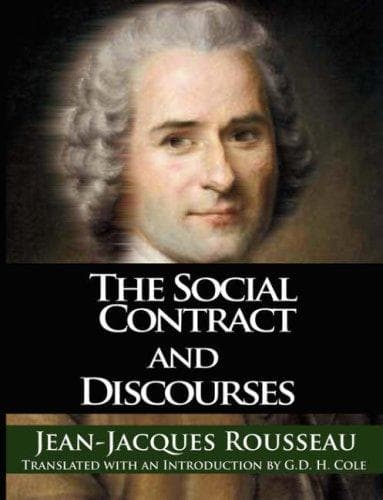
The social contract & discoursesRousseau, Jean-Jacques
Philosophy
The social contract & discourses
Rousseau, Jean-Jacques
Economics; Political science -- Early works to 1800; Social contract
But apart from the public demesne, which is of service to the State in
proportion to the uprightness of those who govern, any one sufficiently
acquainted with the whole force of the general administration,
especially when it confines itself to legitimate methods, would be
astonished at the resources the rulers can make use of for guarding
against public needs, without trespassing on the goods of individuals.
As they are masters of the whole commerce of the State, nothing is
easier for them than to direct it into such channels as to provide
for every need, without appearing to interfere. The distribution of
provisions, money, and merchandise in just proportions, according to
times and places, is the true secret of finance and the source of
wealth, provided those who administer it have foresight enough to
suffer a present apparent loss, in order really to obtain immense
profits in the future. When we see a government paying bounties,
instead of receiving duties, on the exportation of corn in time of
plenty, and on its importation in time of scarcity, we must have such
facts before our eyes if we are to be persuaded of their reality.
We should hold such facts to be idle tales, if they had happened in
ancient times. Let us suppose that, in order to prevent a scarcity in
bad years, a proposal were made to establish public granaries; would
not the maintenance of so useful an institution serve in most countries
as an excuse for new taxes? At Geneva, such granaries, established
and kept up by a prudent administration, are a public resource in bad
years, and the principal revenue of the State at all times. _Alit et
ditat_ is the inscription which stands, rightly and properly, on the
front of the building. To set forth in this place the economic system
of a good government, I have often turned my eyes to that of this
Republic, rejoicing to find in my own country an example of that wisdom
and happiness which I should be glad to see prevail in every other.
If we ask how the needs of a State grow, we shall find they generally
arise, like the wants of individuals, less from any real necessity
than from the increase of useless desires, and that expenses are often
augmented only to give a pretext for raising receipts: so that the
State would sometimes gain by not being rich, and apparent wealth is in
reality more burdensome than poverty itself would be. Rulers may indeed
hope to keep the peoples in stricter dependence, by thus giving them
with one hand what they take from them with the other; and this was in
fact the policy of Joseph towards the Egyptians: but this political
sophistry is the more fatal to the State, as the money never returns
into the hands it went out of. Such principles only enrich the idle at
the expense of the industrious.
Public-domain text, read in full here on John Shaqi.
Reviews
Reviews
No reviews yet
Be the first to share your thoughts on this work.
Elsewhere in the archive
Join the Discussion
Join the discussion
Sign in to leave a comment or review.
Sign InorCreate an account