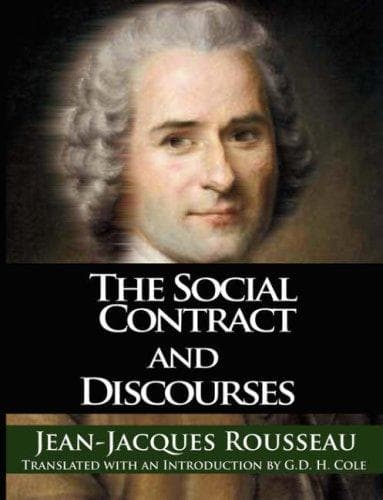
The social contract & discoursesRousseau, Jean-Jacques
Philosophy
The social contract & discourses
Rousseau, Jean-Jacques
Economics; Political science -- Early works to 1800; Social contract
Even if I granted all that I have been refuting, the friends of
despotism would be no better off. There will always be a great
difference between subduing a multitude and ruling a society. Even if
scattered individuals were successively enslaved by one man, however
numerous they might be, I still see no more than a master and his
slaves, and certainly not a people and its ruler; I see what may be
termed an aggregation, but not an association; there is as yet neither
public good nor body politic. The man in question, even if he has
enslaved half the world, is still only an individual; his interest,
apart from that of others, is still a purely private interest. If this
same man comes to die, his empire, after him, remains scattered and
without unity, as an oak falls and dissolves into a heap of ashes when
the fire has consumed it.
A people, says Grotius, can give itself to a king. Then, according
to Grotius, a people is a people before it gives itself. The gift
is itself a civil act, and implies public deliberation. It would be
better, before examining the act by which a people gives itself to a
king, to examine that by which it has become a people; for this act,
being necessarily prior to the other, is the true foundation of society.
Indeed, if there were no prior convention, where, unless the election
were unanimous, would be the obligation on the minority to submit
to the choice of the majority? How have a hundred men who wish for
a master the right to vote on behalf of ten who do not? The law of
majority voting is itself something established by convention, and
presupposes unanimity, on one occasion at least.
CHAPTER VI
THE SOCIAL COMPACT
I suppose men to have reached the point at which the obstacles in the
way of their preservation in the state of nature show their power of
resistance to be greater than the resources at the disposal of each
individual for his maintenance in that state. That primitive condition
can then subsist no longer; and the human race would perish unless it
changed its manner of existence.
But, as men cannot engender new forces, but only unite and direct
existing ones, they have no other means of preserving themselves than
the formation, by aggregation, of a sum of forces great enough to
overcome the resistance. These they have to bring into play by means of
a single motive power, and cause to act in concert.
This sum of forces can arise only where several persons come together:
but, as the force and liberty of each man are the chief instruments of
his self-preservation, how can he pledge them without harming his own
interests, and neglecting the care he owes to himself? This difficulty,
in its bearing on my present subject, may be stated in the following
terms--
Public-domain text, read in full here on John Shaqi.
Reviews
Reviews
No reviews yet
Be the first to share your thoughts on this work.
Join the Discussion
Join the discussion
Sign in to leave a comment or review.
Sign InorCreate an account