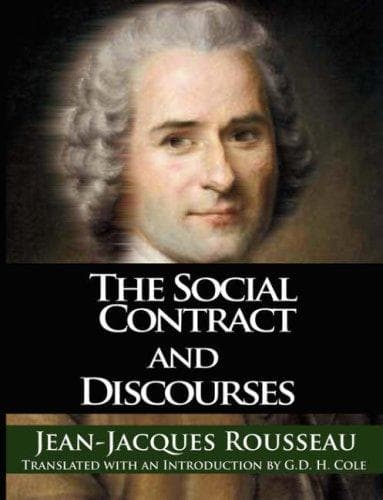
The social contract & discoursesRousseau, Jean-Jacques
Philosophy
The social contract & discourses
Rousseau, Jean-Jacques
Economics; Political science -- Early works to 1800; Social contract
"The problem is to find a form of association which will defend and
protect with the whole common force the person and goods of each
associate, and in which each, while uniting himself with all, may
still obey himself alone, and remain as free as before." This is
the fundamental problem of which the _Social Contract_ provides the
solution.
The clauses of this contract are so determined by the nature of the act
that the slightest modification would make them vain and ineffective;
so that, although they have perhaps never been formally set forth,
they are everywhere the same and everywhere tacitly admitted and
recognised, until, on the violation of the social compact, each regains
his original rights and resumes his natural liberty, while losing the
conventional liberty in favour of which he renounced it.
These clauses, properly understood, may be reduced to one--the total
alienation of each associate, together with all his rights, to the
whole community for, in the first place, as each gives himself
absolutely, the conditions are the same for all; and, this being so, no
one has any interest in making them burdensome to others.
Moreover, the alienation being without reserve, the union is as perfect
as it can be, and no associate has anything more to demand: for, if
the individuals retained certain rights, as there would be no common
superior to decide between them and the public, each, being on one
point his own judge, would ask to be so on all; the state of nature
would thus continue, and the association would necessarily become
inoperative or tyrannical.
Finally, each man, in giving himself to all, gives himself to nobody;
and as there is no associate over whom he does not acquire the same
right as he yields others over himself, he gains an equivalent for
everything he loses, and an increase of force for the preservation of
what he has.
If then we discard from the social compact what is not of its essence,
we shall find that it reduces itself to the following terms--
_"Each of us puts his person and all his power in common under the
supreme direction of the general will, and, in our corporate capacity,
we receive each member as an indivisible part of the whole._"
Public-domain text, read in full here on John Shaqi.
Reviews
Reviews
No reviews yet
Be the first to share your thoughts on this work.
Join the Discussion
Join the discussion
Sign in to leave a comment or review.
Sign InorCreate an account