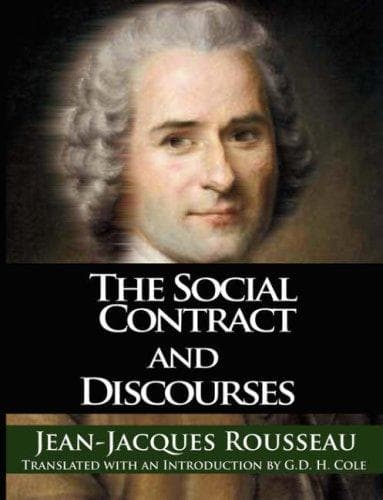
The social contract & discoursesRousseau, Jean-Jacques
Philosophy
The social contract & discourses
Rousseau, Jean-Jacques
Economics; Political science -- Early works to 1800; Social contract
In reality, if it is not impossible for a particular will to agree on
some point with the general will, it is at least impossible for the
agreement to be lasting and constant; for the particular will tends,
by its very nature, to partiality, while the general will tends to
equality. It is even more impossible to have any guarantee of this
agreement; for even if it should always exist, it would be the effect
not of art, but of chance. The Sovereign may indeed say: "I now will
actually what this man wills, or at least what he says he wills"; but
it cannot say: "What he wills tomorrow, I too shall will" because it is
absurd for the will to bind itself for the future, nor is it incumbent
on any will to consent to anything that is not for the good of the
being who wills. If then the people promises simply to obey, by that
very act it dissolves itself and loses what makes it a people; the
moment a master exists, there is no longer a Sovereign, and from that
moment the body politic has ceased to exist.
This does not mean that the commands of the rulers cannot pass for
general wills, so long as the Sovereign, being free to oppose them,
offers no opposition. In such a case, universal silence is taken to
imply the consent of the people. This will be explained later on.
[1] Under bad governments, this equality is only apparent and illusory:
it serves only to keep the pauper in his poverty and the rich man in
the position he has usurped. In fact, laws are always of use to those
who possess and harmful to those who have nothing: from which it
follows that the social state is advantageous to men only when all have
something and none too much.
CHAPTER II
THAT SOVEREIGNTY IS INDIVISIBLE
Sovereignty, for the same reason as makes it inalienable, is
indivisible; for will either is, or is not, general;[1] it is the
will either of the body of the people, or only of a part of it. In
the first case, the will, when declared, is an act of Sovereignty and
constitutes law: in the second, it is merely a particular will, or act
of magistracy--at the most a decree.
Public-domain text, read in full here on John Shaqi.
Reviews
Reviews
No reviews yet
Be the first to share your thoughts on this work.
Join the Discussion
Join the discussion
Sign in to leave a comment or review.
Sign InorCreate an account