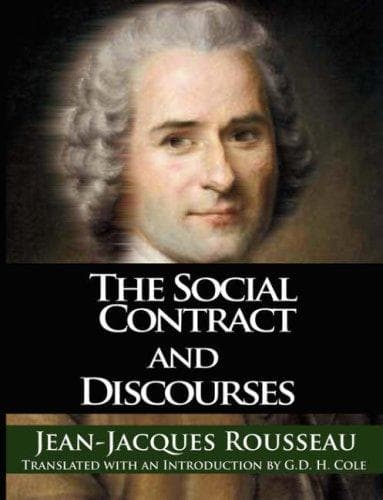
The social contract & discoursesRousseau, Jean-Jacques
Philosophy
The social contract & discourses
Rousseau, Jean-Jacques
Economics; Political science -- Early works to 1800; Social contract
It would be impossible to estimate the obscurity this lack of exactness
has thrown over the decisions of writers who have dealt with political
right, when they have used the principles laid down by them to pass
judgment on the respective rights of kings and peoples. Every one can
see, in Chapters III and IV of the First Book of Grotius, how the
learned man and his translator, Barbeyrac, entangle and tie themselves
up in their own sophistries, for fear of saying too little or too
much of what they think, and so offending the interests they have to
conciliate. Grotius, a refugee in France, ill-content with his own
country, and desirous of paying his court to Louis XIII, to whom his
book is dedicated, spares no pains to rob the peoples of all their
rights and invest kings with them by every conceivable artifice. This
would also have been much to the taste of Barbeyrac, who dedicated his
translation to George I of England. But unfortunately the expulsion
of James II, which he called his "abdication," compelled him to use
all reserve, to shuffle and to tergiversate, in order to avoid making
William out a usurper. If these two writers had adopted the true
principles, all difficulties would have been removed, and they would
have been always consistent; but it would have been a sad truth for
them to tell, and would have paid court for them to no-one save the
people. Moreover, truth is no road to fortune, and the people dispenses
neither ambassadorships, nor professorships, nor pensions.
[1] To be general, a will need not always be unanimous; but every
vote--must be counted: any exclusion is a breach of generality.
CHAPTER III
WHETHER THE GENERAL WILL IS FALLIBLE
It follows from what has gone before that the general will is always
right and tends to the public advantage; but it does not follow that
the deliberations of the people are always equally correct. Our will
is always for our own good, but we do not always see what that is;
the people is never corrupted, but it is often deceived, and on such
occasions only does it seem to will what is bad.
There is often a great deal of difference between the will of all and
the general will; the latter considers only the common interest, while
the former takes private interest into account, and is no more than a
sum of particular wills: but take away from these same wills the pluses
and minuses that cancel one another,[1] and the general will remains as
the sum of the differences.
Public-domain text, read in full here on John Shaqi.
Reviews
Reviews
No reviews yet
Be the first to share your thoughts on this work.
Join the Discussion
Join the discussion
Sign in to leave a comment or review.
Sign InorCreate an account