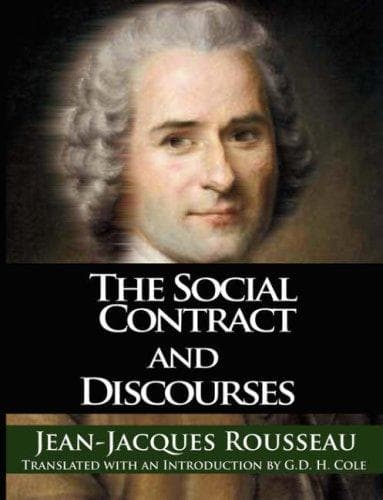
The social contract & discoursesRousseau, Jean-Jacques
Philosophy
The social contract & discourses
Rousseau, Jean-Jacques
Economics; Political science -- Early works to 1800; Social contract
If, when the people, being furnished with adequate information, held
its deliberations, the citizens had no communication one with another,
the grand total of the small differences would always give the general
will, and the decision would always be good. But when factions arise,
and partial associations are formed at the expense of the great
association, the will of each of these associations becomes general
in relation to its members, while it remains particular in relation
to the State: it may then be said that there are no longer as many
votes as there are men, but only as many as there are associations.
The differences become less numerous and give a less general result.
Lastly, when one of these associations is so great as to prevail over
all the rest, the result is no longer a sum of small differences, but a
single difference; in this case there is no longer a general will, and
the opinion which prevails is purely particular.
It is therefore essential, if the general will is to be able to express
itself, that there should be no partial society within the State,
and that each citizen should think only his own thoughts:[2] which
was indeed the sublime and unique system established by the great
Lycurgus. But if there are partial societies, it is best to have as
many as possible and to prevent them from being unequal, as was done by
Solon, Numa and Servius. These precautions are the only ones that can
guarantee that the general will shall be always enlightened, and that
the people shall in no way deceive itself.
[1] "Every interest," says the Marquis d'Argenson, "has different
principles. The agreement of two particular interests is formed by
opposition to a third." He might have added that the agreement of all
interests is formed by opposition to that of each. If there were no
different interests, the common interest would be barely felt, as it
would encounter no obstacle; all would go on of its own accord, and
politics would cease to be an art.
[2] "In fact," says Macchiavelli, "there are some divisions that are
harmful to a Republic and some that are advantageous. Those which
stir up sects and parties are harmful; those attended by neither are
advantageous. Since, then, the founder of a Republic cannot help
enmities arising, he ought at least to prevent them from growing into
sects" (_History of Florence,_ Book vii). Rousseau quotes the Italian.
CHAPTER IV
THE LIMITS OF THE SOVEREIGN POWER
If the State is a moral person whose life is in the union of its
members, and if the most important of its cares is the care for its
own preservation, it must have a universal and compelling force, in
order to move and dispose each part as may be most advantageous to the
whole. As nature gives each man absolute power over all his members,
the social compact gives the body politic absolute power over all its
members also; and it is this power which, under the direction of the
general will, bears, as I have said, the name of Sovereignty.
Public-domain text, read in full here on John Shaqi.
Reviews
Reviews
No reviews yet
Be the first to share your thoughts on this work.
Join the Discussion
Join the discussion
Sign in to leave a comment or review.
Sign InorCreate an account