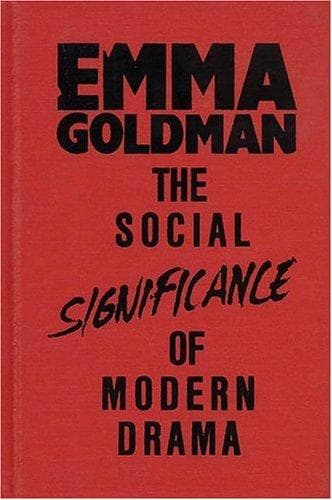
The Social Significance of the Modern DramaGoldman, Emma
History
The Social Significance of the Modern Drama
Goldman, Emma
Drama -- Social aspects; European drama -- History and criticism
_Peter_, a rich peasant, is in a dying condition. Yet he clings to his
money and slave-drives his young wife, _Anisya_, his two daughters by a
first marriage, and his peasant servant _Nikita_. He will not allow them
any rest from their toil, for the greed of money is in his blood and the
fear of death in his bones. _Anisya_ hates her husband: he forces her to
drudge, and he is old and ill. She loves _Nikita_. The latter, young and
irresponsible, cannot resist women, who are his main weakness and final
undoing. Before he came to old _Peter's_ farm, he had wronged an orphan
girl. When she becomes pregnant, she appeals to _Nikita's_ father,
_Akim_, a simple and honest peasant. He urges his son to marry the girl,
because "it is a sin to wrong an orphan. Look out, Nikita! A tear of
offense does not flow past, but upon a man's head. Look out, or the same
will happen with you."
_Akim's_ kindness and simplicity are opposed by the viciousness and
greed of his wife _Matrena_. _Nikita_ remains on the farm, and _Anisya_,
urged and influenced by his mother, poisons old _Peter_ and steals his
money.
When her husband dies, _Anisya_ marries _Nikita_ and turns the money
over to him. _Nikita_ becomes the head of the house, and soon proves
himself a rake and a tyrant. Idleness and affluence undermine whatever
good is latent in him. Money, the destroyer of souls, together with the
consciousness that he has been indirectly a party to _Anisya's_ crime,
turn _Nikita's_ love for the woman into bitter hatred. He takes for his
mistress _Akulina_, _Peter's_ oldest daughter, a girl of sixteen, deaf
and silly, and forces _Anisya_ to serve them. She had strength to resist
her old husband, but her love for _Nikita_ has made her weak. "The
moment I see him my heart softens. I have no courage against him."
Old _Akim_ comes to ask for a little money from his newly rich son. He
quickly senses the swamp of corruption and vice into which _Nikita_ has
sunk. He tries to save him, to bring him back to himself, to arouse the
better side of his nature. But he fails.
The ways of life are too evil for _Akim_. He leaves, refusing even the
money he needs so badly to purchase a horse.
_Akim._ One sin holds on to another and pulls you along. Nikita, you
are stuck in sins. You are stuck, I see, in sins. You are stuck
fast, so to speak. I have heard that nowadays they pull fathers'
beards, so to speak,--but this leads only to ruin, to ruin, so to
speak.... There is your money. I will go and beg, so to speak, but I
will not, so to speak, take the money.... Let me go! I will not
stay! I would rather sleep near the fence than in your nastiness.
The type of _Akim_ is most vividly characterized by Tolstoy in the talk
between the old peasant and the new help on the farm.
Public-domain text, read in full here on John Shaqi.
Reviews
Reviews
No reviews yet
Be the first to share your thoughts on this work.
Elsewhere in the archive
Join the Discussion
Join the discussion
Sign in to leave a comment or review.
Sign InorCreate an account