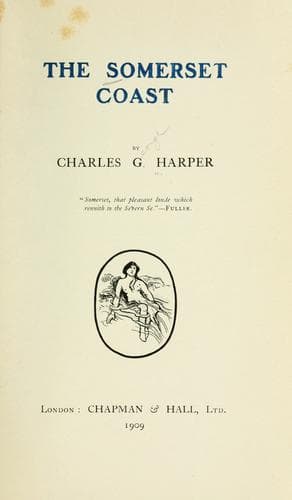
The Somerset CoastHarper, Charles G. (Charles George)
History
The Somerset Coast
Harper, Charles G. (Charles George)
Somerset (England) -- Description and travel
The present explorer was one of those whom circumstances conspire to
bring hither on Sunday, without the prospect of a return in the near
future. He left a bicycle in the gatehouse and came across the meadow,
where the base of the old Abbot’s market-cross stands with a sycamore
growing in the empty socket of its shaft, to the wicket-gate. It being
Sunday, he did not ring, but entered and sat down there in an ancient
archway, in would-be peaceful and holy contemplation. What more
Christian and Sabbath-like spirit than this would you have? Better, I
take it, than the occupation of most of the villagers at that same
moment, reading the Sunday newspapers, filled (after the manner of the
Sunday newspaper) with the raked-together garbage of the last seven
days.
But this holy calm was not to continue. It was entirely owing to that
bicycle. A strategist would have concealed it. Its presence under the
archway of the gatehouse brought the peaceful interlude to an abrupt
conclusion, as shall presently appear.
Within the space of an all too short minute or two there appeared two
little girls through the wicket-gate, coming home to the farmhouse from
a walk, or from Sunday school, evidently excited by the sight of that
machine, and by the very obvious deduction that the owner of it must be
somewhere near. “And very pretty it was,” as Pepys might have put it, to
see them questing about everywhere except in the right place, and not
finding him, sitting there in the grateful shade quite close to them,
and really easily to be seen, you know. And after all, it was the
intruder himself who revealed his own presence, with the remark, “I
suppose you are looking for the owner of that bicycle?” Whereupon they
ran away and there presently entered upon the scene an angry woman, with
inflamed visage and furious words; with offensive epithets about
“trippers,” and the like. Outrageous!
Now, to beat a leisurely and dignified retreat under such circumstances
is difficult. You owe it to yourself not to be ignominiously routed in
disorder, but to draw off your forces from the stricken field calmly and
collectedly, inflicting losses upon the enemy, if possible. And then,
you know, to be styled a “tripper,” and by a fat farmer-woman! Does that
not demand retribution?
Therefore, “Do you presume, woman, to call me a tripper?” seemed the
best retort: effective and injurious, and at the same time restrained
and dignified.
Public-domain text, read in full here on John Shaqi.
Reviews
Reviews
No reviews yet
Be the first to share your thoughts on this work.
Elsewhere in the archive
Join the Discussion
Join the discussion
Sign in to leave a comment or review.
Sign InorCreate an account