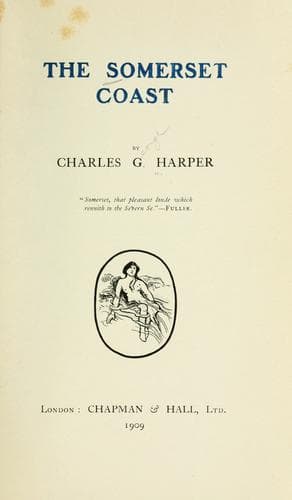
The Somerset CoastHarper, Charles G. (Charles George)
History
The Somerset Coast
Harper, Charles G. (Charles George)
Somerset (England) -- Description and travel
“Y’ant coom up yur to get to Parlock?” asked an old rustic cottage woman
of the present writer, with some astonishment. Being reassured that one
really knew this to be a very indirect route, she abandoned the sarcasm
she was prepared with, and was reduced to satire on visitors in general.
“_Some_ on ’em doan’ niver think of asking the way. They jest goos arn,
an’ then they goos wrong. I often larfs in me sleeve at ’em, I do.”
Saucy puss!
Yes. I suspect the simple countryfolk enjoy many a sly laugh at
visitors, quite unsuspected.
To Selworthy, over North Hill, is a rugged way, of narrow woodland
lanes. Selworthy, as its name sufficiently indicates, is a village amid
the woods; woods around it, above and below; the woodlands belonging to
the Aclands of Holnicote—_i.e._ “Hollen-cot,” or holly-cot,—that seat
lying down beside the main road to Porlock. Here are ancient oaks and
other trees, and more recent plantations that have now matured and
clothed the hillsides with fir and larch. These were planted by that Sir
Thomas Acland who died, aged 89, in 1898. A wild region is that of
Selworthy Beacon, rising to a height of 933 feet, above the village.
[Illustration: PACKHORSE BRIDGE, ALLERFORD.]
The village itself is a small and scattered one, with a large and
handsome church, neighboured by a monastic tithe-barn. A “Peter’s Pence”
chest, hinting, by its size and iron bands and triple locks, great
expectations, is one of the objects of interest here. But tourists from
Minehead and Porlock do not come chiefly to see the church, beautifully
restored with the aid of Acland gold though it be. It is rather the fame
of the pretty thatched cottages bordering a village green that attracts
them. These owe their origin to the late Sir Thomas Dyke Acland, who
built them as homes for servants grown old in his employ, and pensioned
off by him.
The road down from Selworthy to Porlock passes the little river Horner
and commands views on the left hand up to the purple hills of Exmoor, up
to Cloutsham, where the wild red deer couch, and the great heights of
Dunkery, Easter Hill, and Robinow. To the left lies the hamlet of
Horner, so-called from the river, “Hwrnr,” = “the Snorer,” snoring, as
the Anglo-Saxons are supposed to have fancifully likened the sound of
its hoarse purring, over the boulders and amid the gravel-stones that
strew its shallow woodland course. Here, amid the woods, you may find,
not far from a comparatively modern road-bridge, an ancient packhorse
bridge flung steeply across the stream. At Allerford is another
packhorse bridge.
------------------------------------------------------------------------
CHAPTER XX
PORLOCK—BOSSINGTON—PORLOCK WEIR
Public-domain text, read in full here on John Shaqi.
Reviews
Reviews
No reviews yet
Be the first to share your thoughts on this work.
Elsewhere in the archive
Join the Discussion
Join the discussion
Sign in to leave a comment or review.
Sign InorCreate an account