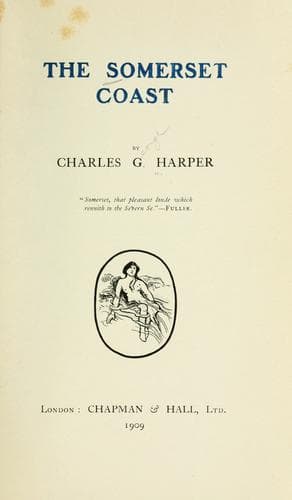
The Somerset CoastHarper, Charles G. (Charles George)
History
The Somerset Coast
Harper, Charles G. (Charles George)
Somerset (England) -- Description and travel
ALL the ebullient modernity of Weston is looked down upon by the
immemorially old, from that overhanging vantage-point, Worle Hill, where
the ancient camp and fortress of Worlebury, dwelling-place and
stronghold of many ancient peoples, shows traces of occupation by a race
who flourished some four thousand years since. Worlebury passed through
many hands, but the last people who sheltered there died in ruthless
battle thirteen centuries ago.
Worlebury rises to a height of 357 feet above Weston, and although
modern villas here and there impinge upon it, and the spire of Holy
Trinity Church and the unlovely backs of houses are a thought too
insistent from these grey ramparts of prehistoric times, it is in many
ways as remote from the seething crowd beneath as its height would
imply. The camp of twenty acres is divided into two unequal parts by a
ditch. It is conjectured that the larger portion was the place of
refuge, and the smaller the actual fortress, of the race who constructed
it. The whole is irregularly enclosed by ramparts of loose pieces of
limestone and rocky banks, roughly of live successive ranges, but here
and there, in places thought weakest, of as many as seven. On the side
facing the sea, where the limestone rocks of Worle Hill go precipitously
down, and artificial defence was not required, there are no ramparts.
This hilltop was until about 1820 a barren spot, quite innocent of
trees, but the plantations made at that time by the Smyth-Pigott of the
period have by now resulted in a crown of beautiful woodlands of larch,
oak, and other trees. Amid these woods the extraordinary ancient
ramparts of loose limestone fragments, the broadest of these defences
about a hundred feet across, glimmer greyly, like petrified rivers. The
flakes and knobs of stone, broken up and placed here in such immense
quantities and with incredible labour, vary in size from about that of
an ordinary brick to three times those dimensions, and are as clean and
sharp to-day as though but recently quarried.
It is not an easy matter to climb over these successive banks and
ditches, and it is quite evident that those who at different periods
stormed these defences and slew those who occupied them, must have been
determined people, little daunted by the losses they must needs have
suffered in the advance. The early defenders were men who used the sling
for chief weapon of defence, and great numbers of slingers’
platforms—little flat spaces contrived in strategical positions along
the sloping sides of the hill—remain, like so many primitive artillery
emplacements; while quantities of their ammunition—pebble-stones that
are not in the course of nature found on the crests of limestone
hills—may be picked up.
Public-domain text, read in full here on John Shaqi.
Reviews
Reviews
No reviews yet
Be the first to share your thoughts on this work.
Join the Discussion
Join the discussion
Sign in to leave a comment or review.
Sign InorCreate an account